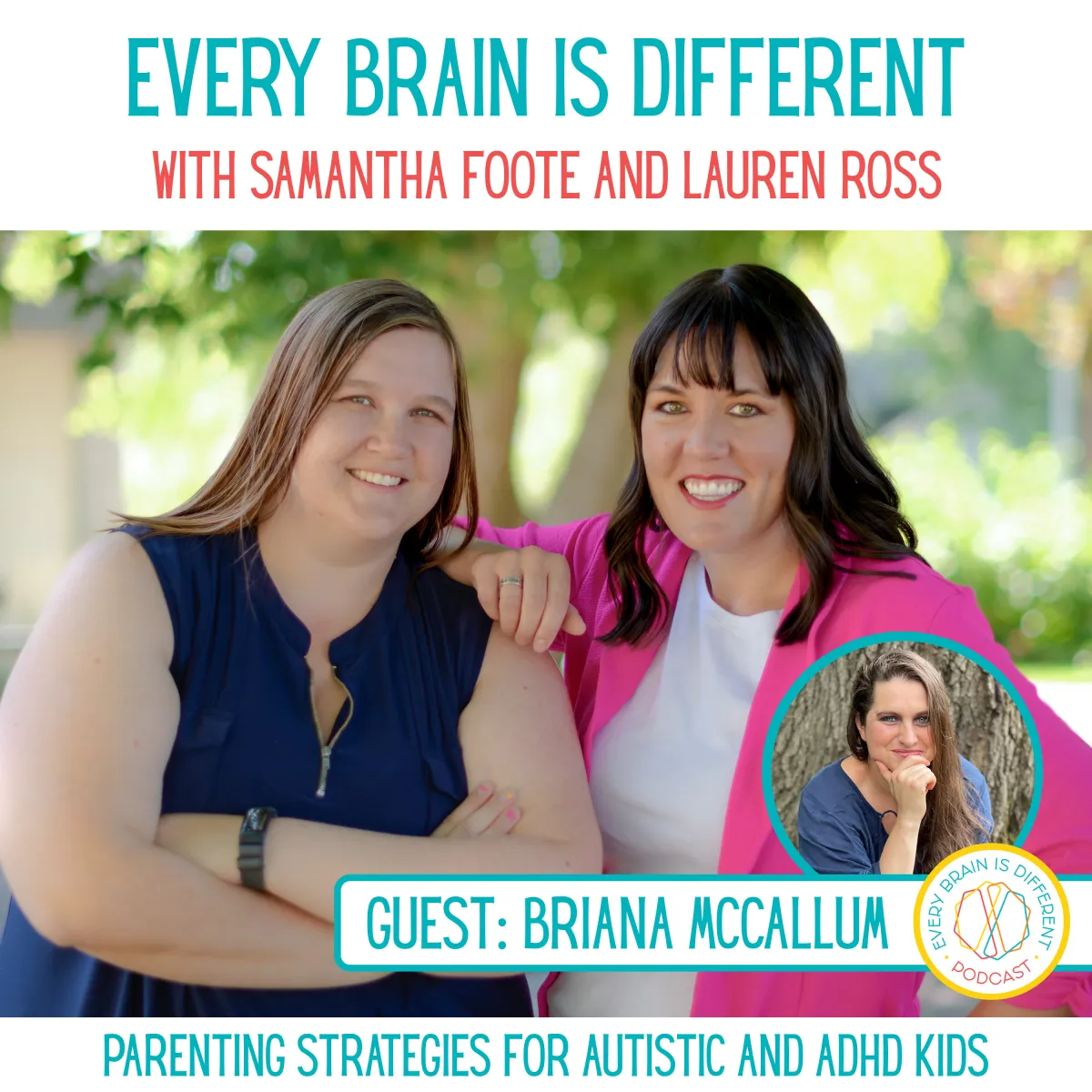
89- The Dopamine Menu: Practical Strategies for ADHD and Autistic Kids (and Parents!)
Connect with Samantha Foote!
Instagram:https://www.instagram.com/everybrainisdifferent
YouTube:https://www.youtube.com/@everybrainisdifferent
Welcome to Every Brand is Different, the podcast where we celebrate the unique world of neurodiversity. We are your hosts, Samantha Foote, a neurodivergent board certified music therapist and mom to three kids of ADHD and autism, and Lauren Ross, an ally to the neurodivergent community with over 10 years of experience supporting children and adults with autism.
This podcast is for parents like you. Navigating the world of neurodiversity with love and compassion. Together we'll create a world where every brain is valued and celebrated. We're excited to embark on this enlightening journey with you.
Transcript:
Samantha Foote: [00:00:00] Welcome to the Every Brain Is Different podcast. Lauren and I are here with Brianna McCallum and she is a multi-passionate entrepreneur, investor, and healer specializing in integrative wellness as an empowerment life coach, Reiki master, organic tea blender and spiritual development coach. She helps clients achieve [00:01:00] balance through a holistic trinity model- mental, physical, and spiritual wellness. She focuses on empowering neurodivergence and their caregivers with trauma-informed coaching, guiding them through diagnoses and challenges to foster personal growth and supportive relationships.
We're so excited to have you on the show! Thanks for coming.
Briana McCallum: No problem. Thanks for having me.
Samantha Foote: And can you tell us a little bit more about how you're involved in the neurodivergent community?
Briana McCallum: I can, uh, do you want personal or professional first?
Samantha Foote: Whatever you want.
Briana McCallum: Okay, I'll start with the professional side first.
Okay, so I work with a company called Kula. It's findyourkula.com is the website, and the Kula community is specifically made by neurodivergents and for neurodivergents. There's a group of life coaches that all got certified together and went through what us neurodivergent folks do, and we're overwhelmed with information and have to be on social platforms and
have constant pressures and task [00:02:00] demand avoidance coming up and integrating with neurotypicals. And we decided, you know what? We'd love to have a growth platform and support platform that helps do a lot of the things that were brought to us, but that is more neuro spicy friendly. We, we prefer spicy in that group.
And so, uh, Maddie Richardson and Erica Schoop created the foundation for the Kula community, and then a group of us as the founding members gave it a test drive and we, we do workshops and webinars and have meetings weekly and journaling and do a lot of education and just help support people through their diagnoses.
So that's the big one, professionally in a group setting.
Samantha Foote: We actually interviewed Erica on the podcast last year, so she told us all about the community, so that's amazing that you work with her. I love that. So cool.
Briana McCallum: Yeah, she's a beautiful human.
Samantha Foote: Yeah, I, yeah, I love her [00:03:00] energy. I just love everything about her.
Briana McCallum: She's great. Uh, I've really enjoyed working with them. Uh, but that's, that's been my biggest professional work and a lot of that, it's, it's free work. I mean, we're just, we're out there just trying to create a safe space for people to really learn and grow. And then in my coaching business, I've had quite a few paying clients that come in specifically because they're just overwhelmed by it all because no matter what your brand of neuros spicy is. It can be overwhelming. The world is just not really set up for us as a whole, and so something that I'm very gifted in is turning symptoms into superpowers. So, helping people tap into what's considered a symptom or a dysfunction by society and utilizing it as the superpower that it is because our brains and our bodies just work differently. It may be dysfunctional according to societal standards. However, we work at a hyper pace. We're at hyper speed all the time, and it's why [00:04:00] we process differently. And when we're able to tap into those, those symptoms or those superpowers, and we're able to utilize 'em for the best interest of us, our family, our work environment, whatever it is. It completely changes our mindset and our dynamic and our habits. I'm also a mindset coach, so that's a big piece of it is if you look at yourself as broken, you will function as if you are broken. If you think you are burden, you'll constantly be burdensome to others. However, if you recognize that you were gifted and you were special, and you were beautiful, and you are talented and you can utilize your unique talents to succeed and support and help others and yourself, that's the pathway you're gonna find.
Samantha Foote: Yes. It's all about mindset. My mom was telling me she works at a school, and she has some kids come in and they say, “I can't do that, I have autism”. Or “I can't do that because I have ADHD.” And that's, or they say, “my mom told me I can't do this because of my autism” or whatever, and I'm just like. No, like you, so for a long time my [00:05:00] mom was like, don't get your kids diagnosed don't like she was against getting a diagnosis because she worked with these kids who said, I can't do that because I have this diagnosis. Where then other kids would come in and they'll be like, I can do this. Because I have ADHD, this is my superpower. And so, it is definitely just all about mindset and if you do get a diagnosis, like it can either, you can go one of those two ways. Like you can embrace it and be like, yes, this is who I am, this is how my brain functions, this is how I'm going to contribute to society with my quote unquote superpowers. So, what would you say to people who maybe have that mindset of, I can't do this because I have this diagnosis.
Briana McCallum: The, the simple answer is you change what you think, you change what you see. And the expanded answer on that is whatever we tell our brain, it's like our engine. If we press the gas on the car, it's gonna [00:06:00] rev up the engine so it goes faster. If we hit the brake, it's gonna slow it down. It's the same way that our brain works, it's a muscle. So if you're constantly feeding that fuel to your brain of, I can't, I'm not good enough, I'm incapable, I'm unable, I am like identifying with the symptom-- I am overwhelmed. Your brain's job is to show you proof of that because you've given it a command. This is what I am, this is what I need to see, this is what I can't do. So your brain says, okay, let's make that a reality, that's what we do. So the best thing you can do is flip that script. You just rewrite the narrative. You start saying, I can do this if that's too much at first, totally fine. It was too much for me at first. Say, I am learning to be better at this, or I am practicing this thing. so instead of it being. I'm really bad at staying focused. It's, I'm practicing focusing and being more productive, or I am constantly improving at focusing and being productive and also self-compassion and empathy. That's a huge [00:07:00] part of it because everybody needs that. But also, when you've gone your whole life, number one being told, 'cause a lot of that does come from, from caregivers and well-meaning leaders of these children. they're imprinting those self-limiting beliefs in their minds. When you've gone your whole life doing that, it atrophies that part of your brain that tells you the opposite. So you have to rebuild it as, like I said, I, I like the comparison of a muscle. The brain is a muscle, whatever you work, the bigger that muscle is gonna get.
So start saying, “I can” start saying “I'm improving”. Just change the narrative. And I also started adding, working with caregivers of neurodivergents as well for exactly what you brought up that, well, “my mom told me that I can't do this” 'cause they don't, obviously no parent is gonna intentionally hurt their child, but what they don't realize is they're, they're limiting that child. They're starting 'em out on the wrong foot because now they are [00:08:00] gonna struggle not realizing that they never had to do that. One of the best things you can do is recognize a child is neurodivergent and give them the tools that they need to succeed; same with an adult, but don't put 'em in a box. Don't isolate 'em. They, you still, we still have to interact with the outside world, but we have to find our guardrails. It's just, okay, this is way too freaking much. The wind's blowing and my sensory overload is going nuts. And there's all these noises and there's all these people around, and I can feel all these energies and my thoughts are going a thousand miles a minute, and I'm kind of hungry right now when all that happens all at once, if you teach a child to be aware, instead of saying, “oh, well you're autistic or you've ADHD, so it's just too much for you. You can't be in this”. What are you thinking? What are you feeling? What do you need? Right? Identify. Redirect. Super simple. So that way we're constantly preparing, preparing, preparing. So, okay, I know I need my noise canceling earbuds with me. That needs to be around. I know I need to have my worry stone in my pocket so I can focus on that. Instead of all the things going around, I know I have to be in this crowd. So let me take that route that goes [00:09:00] around the crowd a little bit, or let me take some breaks.
Samantha Foote: Yes. I love how you talked about getting accommodations for what you might struggle with, so I, I like the worry stone that you talked about, like having something that you focus on so you're not focusing on the other things. It reminds me of that show, what's it called with the autistic doctor? I love that show.
Anyway, Freddie Highmore plays the doctor. Anyway, the doctor, he is autistic. He is super autistic; I guess you could say. I don't know. He's autistic and he has a really traumatic past, and his brother gave him a, a play blade like a scalpel. And so, whenever he's, and he's a surgeon, and so whenever he is having issues or he's like worrying about something or he's overwhelmed with something, he just grabs that scalpel and he just [00:10:00] touches it and like just feels it, like rubs it back and forth.
Hey everyone, Samantha here, and I'm thrilled to invite you to join me for something special, the Parenting Power Hour. This is your chance, parents and neurodivergent kids, to bring your questions directly to me and fellow parents in the room.
We're here to help you develop actionable plans that really work so you can finally stop the meltdowns and find peace in your home. As a mom to three kids with ADHD and autism, I've seen and been through the challenges too, so trust me, we'll find solutions together that fit your family. Don't miss out on the Parenting Power Hour.
It's a free online monthly gathering every second Thursday of the month, from 12:45 to 1:45 Mountain Standard Time. Visit everybrainisdifferent.com to reserve your spot today.
I don't think a lot of people think about that, that if you are having anxiety or you're overwhelmed or something is just too overstimulating for you, if you can just have an object that [00:11:00] you can just hold and feel it, and feel the smooth or if it's rough or just think about different things with that object. Like for him, his brother passed away and so he thought of his brother and what his brother would say in that moment. Beause his brother was the one that always calmed him down when he got overwhelmed. And so that when he grabbed onto that scalpel, that's what he thought about.
I just don't think a lot of people think about having an object like that and how powerful it can actually be. So that just, it just reminded me when you said that. Are there other things that you would say to parents who are raising neurodivergent kids to kind of help them find accommodations for the things that they struggle with or anything like that?
Briana McCallum: Absolutely. There are so many resources out there. Educating yourself is the best thing you can do. So whatever your child's diagnosis is, read up on it or audio books. You can play anything while you're driving or walking or doing [00:12:00] the dishes, whatever. And just really educate yourself on whatever that is.
For me, my child has ADHD with anxiety, so “ADHD 2.0” is one of my favorite books. Also in the Kula community, all “AuDHD” A-U-D. AuDHD is one that we reference a lot there as well. We, we have a pretty big book list there. Anything you can get your hands on just to, to really learn as much as possible about what to look out for because there are things with neurodivergent kids that may not seem like it's a symptom, so to speak, but you don't recognize it until, well, later on in life or now it's become an issue or it's become an obstacle. So the more knowledge you have, the easier it is to go, Ooh, actually this may be autism related, or this may be anxiety related, this may be ADD related.
And then you can really, as a parent, start seeing those precursors to, okay, my child has started—Mine, she has little ticks when she's starting to get anxious before the meltdown [00:13:00] ever happens. And it'll be sucking her thumb or messing with her ear or messing with my ear for comfort of just seeking sensory things or sometimes, when it's more the ADHD than the anxiety, it's high sensory seeking, like she wants super stimulation, just everything all the time nonstop. Which, for my ADD, it's, we're polar opposites. I'm like, oh, this is too much. She's like, I love it.
Samantha Foote: Yeah, yeah.
Briana McCallum: But I also know that's a sign that when she's getting zoomy is she has some energy that she needs to get out, but there's also some stuff going on up here, which is it's good for her to move her body so we know, all right, we're gonna stay away from sugar today, which you should anyways, and caffeine like definitely keep those minimal outta the mix. And let's, uh, let's really fuel our body and let's have some mindfulness. Let's make sure we like go climb a tree or play in nature, get our hands in the dirt, build something, go to the park. And just really spending time too. That's another thing is you can't spend enough time ithw your kid [00:14:00] because that's, that's really how you learn them the best. And that's how you teach them and model to them what tools they can use to practice them together and sometimes you, you're not gonna be able, oftentimes, you're not gonna be able to do it in the moment. You need to do it outside of those meltdown times. So you practice them and it becomes a skill that's already familiar. And we use cognitive play-based therapy in our house a lot. So we'll act out a scenario. And we'll play it out, and then we'll utilize those coping skills in that play scenario. So then when it comes to an actual meltdown or overwhelm moment, she's already got that tool. And if it's going well, I can say something to trigger it or, “Hey, let's try this”, and it'll work. If it's not, she may just still have the meltdown and go take some space, but she'll still end up doing it because it's already like a seed that we've planted and watered over time.
Samantha Foote: Yes. Practicing when you're not in the moment of crisis is so important because if you're like, “okay, we're gonna do [00:15:00] this”, and your child has never even heard of that before and they're in a crisis, they're not gonna hear what you're saying. They're not gonna do what you're asking them to do because they, they're in crisis. They don't know what's going on and
Briana McCallum: Exactly.
Samantha Foote: And then I noticed a lot of people tend to just talk a lot when there's a crisis or when your child is escalated. So if you can, I can guarantee you, your children cannot hear you. They cannot process what you were saying to them when they are that escalated and so if you do practice like the emotional regulation strategies before, or the anxiety strategies or whatever. Then they're able to use those strategies because your, like you said before, your brain is a muscle, like your brain will be like, “oh yeah, this is what we do”, and so then they can calm down maybe a little bit easier.
Briana McCallum: Absolutely. And we have, uh, a dopamine menu as well because for most neurodivergents, we [00:16:00] don't produce as much dopamine, just normally we have to do a little bit more. Uh, so what we've done, there's a few different ones, but we have a dopamine menu that's got the wholesome dopamine, things that are really good for you and then we've got more like the side items that are just fidgets and things like that. And then we've got the junk food and the dessert that's like a treat or some kind of quick fix. And then we've got, I can't remember what the last one in, but there's another one that's more like the big dopamine hit of we're we're gonna go out and do a special meal, or we're gonna go on a trip, we're gonna do something like that, but, I found that to be helpful as well, because sometimes I can redirect her in those overwhelm moments where she's just like mad and throwing a fit and I, I like to really, not mockingly, obviously, but make a big deal of it. “I hate this man. I hate it too. This is dumb. I wish it was, whatever”. And then sometimes we'll get to the point where we're acting out what we wish it was and it's so impossible where there's now unicorns and dragons and all kinds of stuff that it's absolutely ridiculous and we're laughing. [00:17:00] Uh, but I also use those moments to, to add to that dopamine menu. Okay, well this is something that she's thinking about in those moments. So even if we're going into imagination and dragons and unicorns, sometimes just having an escape moment is needed, adults do it. We get in our phones, we get on social media. Kids need that too. And my 8-year-old will straight up say, I am overwhelmed. It's been a long day. I'm stressed out. I just wanna veg out on my game, and that's all I wanna do. I'm gonna snuggle with you and I want a veg, and I, I want pizza for dinner.
Okay, well let's do that. As long as homework gets done, that's fine. But I now know that those are her things that's on her dopamine menu and it's helpful. And then movement, like I can't, I can't stress movement enough, 'cause you'll notice a lot of kids, like, that's why they, they throw tantrums, they're throwing their bodies around, they're moving a lot. Then that, that somatic response, it's normal. We need to move that energy out of our bodies. And I would highly recommend studying the vagus nerve as well, because if we have vagal nerve stimulation, [00:18:00] it bypasses our dysregulation and enables us to calm down almost instantly.
Difficult to get children to do it, but if you can start teaching it, it's very helpful. So there's a, there's a punching bag that hangs in my kids' room and on her door I have punching bags. A lot of neuro divergent kids, when they get super overwhelmed, they can get a little physical 'cause they're having trouble expressing it.
So I just keep those there. If she's really stressed out, nothing else works. Hand her her cute little unicorn punching gloves, pull out the mitts and start hitting, and I'm, company over and everything. I don't care what's going on. We're about to hit some stuff and I,
Briana McCallum: had I had a brand new person over to my house who saw it.
“It was solid parenting.” “Really? Because it felt super awkward. Thank you.”
Samantha Foote: No, if you're giving your kid what they need, like in the moment, like kids don't care if people are over. They don't care what's going on. Like when they get overstimulated, they need interventions to help them calm down. And that is solid parenting. That's amazing. Well, thank you so [00:19:00] much. You've shared great resources and fantastic strategies to use. I love the dopamine menu. I have never heard of that before, put in that way. And so just, you can even ask your kids what, what helps you? What gives you joy? What does this, and then be curious and just
Briana McCallum: mm-hmm.
Samantha Foote: Look and see what they asked for. Your daughter said, I want this, I want this, I want this. Well, those are all definitely things that are on her dopamine menu that make her feel better. So I love that. I'm gonna do that with my kids because they throw fits and I don't know what to do sometimes. So we're gonna do that.
That's amazing. Where can people find you online?
Briana McCallum: So my website is lmhtea, like the drink, L-M-H-T-E-A.org. And if you go to my holistic health and wellness coaching, that's where you'll find an area to book me. You can book a free consult with me. Anytime I'm, I'm always willing to give 30 minutes of my time just to help out [00:20:00] and give some advice. Anybody can do that once a month. Can't do it nonstop, 'cause obviously got other things I gotta do. Yeah. Um, but you know, if, if you just need some advice, feel free to book a consult on me. I'm also on YouTube getting that channel built up. I'm on LinkedIn, Instagram and Facebook. I'm not huge on social media, but you can, you can peruse through some of the stuff I've put up. And yeah, I, I love, I love coaching. I love helping people. I love supporting and empowering folks. So even if, even if you don't wanna book a whole session with me and you just wanna chat, I'm down. I enjoy it.
Samantha Foote: Awesome. Well that's very generous of you like to do it once a month. Like usually people are like, you can do it one time and then you have to pay me. So I love it. So our last question is, what do you do for fun?
Briana McCallum: Oh, that's a long list. Music, I love, love music, listening to music, making music. I, I play piano and I'm a writer and I also play with a local symphony. And every now and again I'll jam with bands. [00:21:00] Uh, not when it's cold like it is now, but I do gardening. I like getting my hands in the dirt when I, when I'm feeling emotionally dysregulated, especially if it's overwhelmed to the extent that it's like multiple days, it's impacting me. Getting out and creating a new little garden bed or planting some flowers is one of my favorite things to do, 'cause then every time it re blooms, I can think about getting through that time, and that's become a bit of a pattern for me. And the yard's gotten really nice because of it.
Samantha Foote: Nice. Nice.
Briana McCallum: I also like to cook for other people. Not so much for me. Love cooking for other people. I'm into martial arts. I've become a bit of a gym rat, like hanging out at the gym. It's a cool place to be. Feels, feels good to keep my body moving and then just playing. I'm a giant kid. I'm that mom that I'm out on the playground with the kids. I am sometimes just as disruptive as the children.
Samantha Foote: That's amazing.
Briana McCallum: Yeah.
Samantha Foote: I love how all the things you do for fun are very healthy things to do, so that, that's [00:22:00] awesome. Yeah. So thank you so much for coming on the show. We really appreciate your time and if people wanna hang out with you, just book a consultation and Yeah. Yeah. Cool. Thank you.
Briana McCallum: Look forward to connecting. Thank you so much for having me.
Samantha Foote: Yeah. Yeah. Well, Lauren, what did you think? What were the highlights?
Lauren Ross: Oh my gosh, so many. I love her. Uh, like you said, I'm super excited about this and just a dopamine menu. Like we all have the things that we know that will help us and get that, but like to have a term or like a thing, like a dopamine menu. Like I legitimately wanna make like a drawn menu, but like I wanna get real creative.
Samantha Foote: Yeah,
Lauren Ross: I think that's amazing. I, uh. A favorite reminder. Uh, she's, she mentioned it a few times and then just even herself, she's just big kid. I wanna play. I think play is so forgotten as an adult and it can be good for us, but also for your kids. That's where we [00:23:00] can get a lot of teaching done is through play. So, do not forget to just go out and play with your kids. Play in the dirt, get outside, climb a tree. Don't forget those like little things 'cause they can have such huge impact on later. And they are such good like teaching moments, especially when you can integrate those coping skills, 'cause like we say, and repeatedly say like we, we can't teach those in the moment, in a crisis. We have to do it before. So we can remind them of it when they are in that crisis moment. And so, uh, I really love that. And then again, a reminder to parents, like, don't set up your kids to fail. Just 'cause they have the diagnosis. Like, it is not, they can't do, it's what they can do and or what, you know, adaptations, they might need to do that. Um, and so I, again, I appreciate that reminder every time it happens, happens. Um, because I think it is really important, and that's how we can shape that [00:24:00] mindset of. I can do this or I will be able to learn, or I can try. I, I think that's really important, so.
Samantha Foote: yeah, for sure. Just, I think it's okay for parents to be realistic with their kid and say, this might be hard for you, but we're gonna find a way to do it if you really wanna do it, let's say. Going back to that show that I was talking about, which is The Good Doctor, by the way. That is the name of it. And it came to me.
Lauren Ross: I knew what you're talking about, but I was like, I don't, it's doctor, it's,
Samantha Foote: yeah, it's the Good Doctor. Anyway, in the show, he's, I wanna be a surgeon, but his communication differences are so severe and the way he works is so different than the neurotypical peers that
everyone's, you're not gonna do that. You're not gonna survive residency, you're not gonna survive this. But he has accommodations in place and he tells [00:25:00] people, I'm autistic. This might seem a little different to you than your normal interactions with other people. Mm-hmm. And then he has a mentor that's really helping him through, and I know it's all fictional, but I think it's very good for real life.
Lauren Ross: It’s a lot of real life applications.
Samantha Foote: Yeah, it has a lot of real life applications. If you wanna do something, find a mentor, find, tell people up front, Hey, I'm autistic and or I have ADHD, and so these are some of the things that I do that you might not be familiar with.
Lauren Ross: Yeah.
Samantha Foote: Tell people.
Lauren Ross: I, I think with, with kids too, and we've had a few people mention this and I can't remember names, I'm sorry, but the, if your kid has an interest in truck driving or whatever, 'cause I know a lot of kids like, just like big trucks and tractors find them someone, a truck driver that's willing to show them and mentor them or whatever. Or even if it's just, just to get them to see and look and experience. Even if it's just like one time. [00:26:00] Yeah. And just say, well, no. It's not gonna, you don't know. You don't know.
Samantha Foote: Yeah. Yeah, exactly. So, awesome. So if people are interested in learning more about Brianna, which I, at the beginning of the episode when I paused at her name, it was because I was like, is it Brianna?Is it Brianna? I don't know what I'm talking about right now, so.
Lauren Ross: I was more concerned about her last name.
Samantha Foote: Yeah. Yeah. Um. Just message her. She is fantastic. She was involved in, she was one of the panelists for the Neurodiversity and Harmony Summit last fall, and she was amazing. So yeah, definitely check her out. Check out the Kula community.
Lauren Ross: And that's what I was gonna say, check out Kula.
Samantha Foote: And let us know what you wanna hear about on the podcast. Let us know what, what you're struggling with, who can, if we can answer the question or if we can get someone to come in and answer the question. We are always looking for new ideas and what [00:27:00] everyone wants to hear about. So thank you for listening this week and we’ll see you next week.
Lauren Ross: Thanks guys.
Thank you for listening to today's episode. We hope this discussion on neurodiversity has provided you with support, understanding and inspiration. If you're looking for more support, Or you can go to everybrainisdifferent.com and download the ultimate guide to parenting your neurodivergent child.


