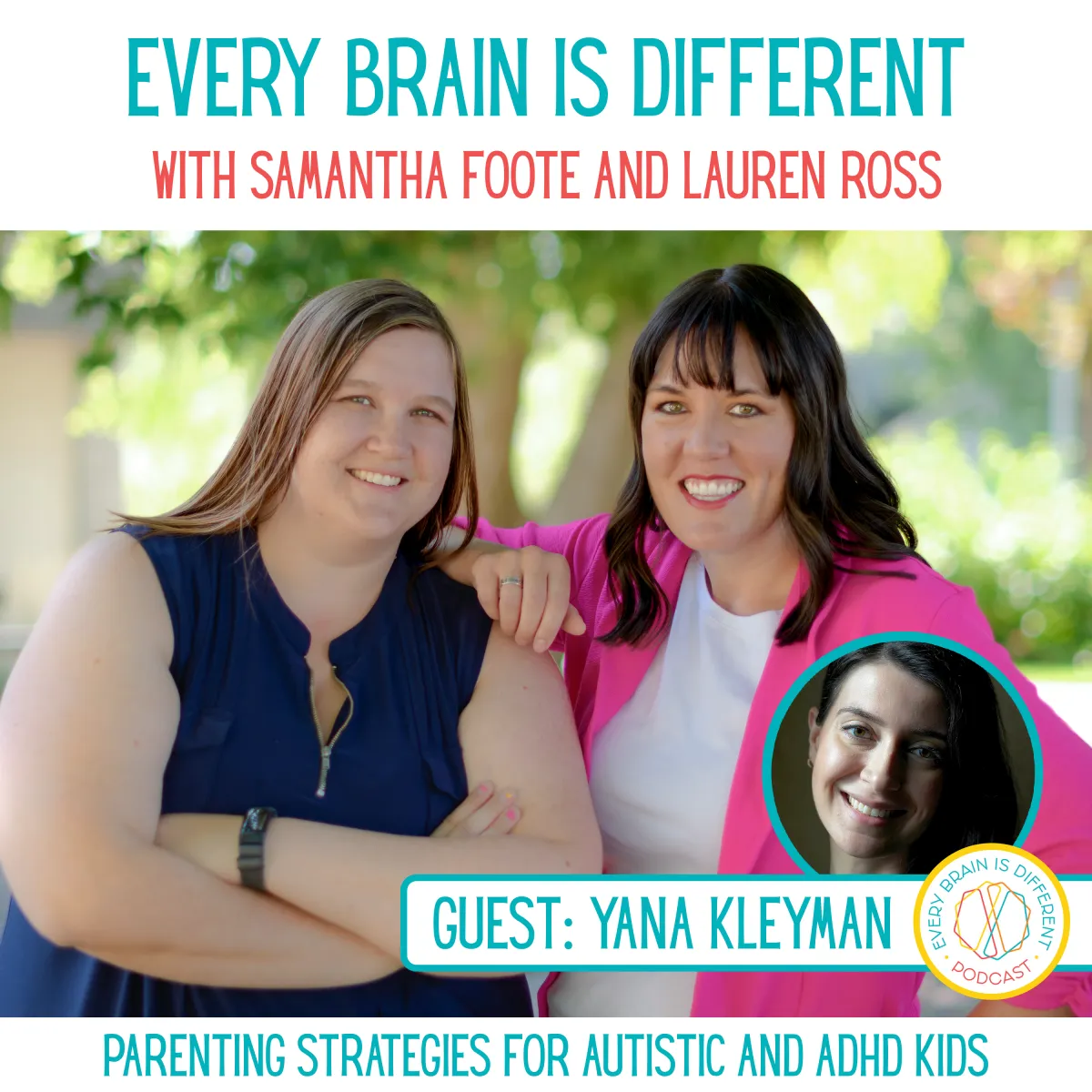
138- Rethinking ADHD and Autism Treatment with Functional Medicine Expert Yana Kleyman
Connect with Samantha Foote!
Instagram:https://www.instagram.com/everybrainisdifferent
YouTube:https://www.youtube.com/@everybrainisdifferent
Welcome to Every Brain is Different, the podcast where we celebrate the unique world of neurodiversity. We are your hosts, Samantha Foote, a neurodivergent, Board Certified Music Therapist and mom to three kids of ADHD and autism. And Lauren Ross, an ally to the neurodivergent community with over 10 years of experience supporting children and adults with autism.
This podcast is for parents like you. Navigating the world of neurodiversity with love and compassion. Together we'll create a world where every brain is valued and celebrated. We're excited to embark on this enlightening journey with you.
Transcript:
Samantha Foote: [00:00:00] Welcome to the Every Brain is Different podcast. It is Samantha and Lauren here with you and today we have a special guest, Yana Clayman. She is a functional medicine health consultant who discovered her true calling through a personal health crisis. At 33, she, she had unexpected health challenges that led her to explore alternative methodologies unveiling the transformative [00:01:00] power of root cause medicine. This pivotal experience inspired her to transition from traditional healthcare as a Pharm D of nearly 20 years, to dedicating her expertise to helping children with ADHD and other developmental disorders thrive naturally. Yana's unique approach offers families, hope and practical solutions. Her mission is to empower parents and children challenging predetermined futures and fostering radical health transformations that allow each child to reach their full potential.
I love how you, your mission is to challenge predetermined futures. That is amazing because I know someone, or actually a lot of people, who are diagnosed and the doctors are like, “They'll never do this. They'll never do this. They'll be like this their whole life.” And so I love that you were just challenging that and being like, “No, there are other things possible.” So that's, that's fantastic.
But can you tell us a little bit more about how you're involved in the neurodivergent community? [00:02:00]
Yana Kleyman: Yeah. Thanks Samantha. I, honestly, that's one of the things that is my, my main mission to, to change that because of my, my own journey, I kind of came into functional medicine and working with neurodiverse kids through my own health crisis and healing journey. And I, myself was given a, a predetermined future. Like you said, when I was 33, I went from being a super healthy person, I thought I was healthy. I had zero diagnoses or health concerns, to my body just breaking down. I wasn't able to get through the day. I was in immense pain, and after doing the whole workup and seeing a ton of people and specialists, I was told that I would be bedridden within 10 years. I was given lots of labels, a very set, predetermined future. And I have two kids, like my, my baby wasn't even two years old at the time. And so my whole life, my whole reality, everything I'd ever envisioned just came crashing down. And that was really the, the moment where [00:03:00] I, I was given all these meds and I, as a pharmacist, I knew exactly what my life was gonna look like, the side effects and, and everything they had told me. And I don't know, I didn't know what else was out there. I don’t know what came over me, but I just knew there had to be another way. And so I left that office. I, I said, “No, thank you.” They were gonna just inject me right there with medication. And so I know firsthand what it's like to have a predetermined future and that's how I found functional medicine. It's almost been 10 years. The reality that was laid before me is not my life. I actually healed within months. Like something that they said was gonna be years, I found healing in months, and that's when I went back, I retrained, I became a functional medicine practitioner and I specialize in pediatrics, ADHD, because these kids are the ones that get labeled all the time. They get told from a really young age like what their life is gonna look like moving forward, mostly the parents. And the [00:04:00] only options we're given is, is medicine, right? Like you take this medication and as a pharmacist, I know exactly what that means for them. And you know when they start at six, by the time they're 10, they've already tried three or four medications, changed doses, and for some kids it's okay and it works and that's great because we need to help our kiddos out any way we can. But, there's a large percentage of kids for whom it's not working and, and parents have nothing else to do and nowhere else to turn because we're kind of told, “Okay, medication's not working, something's wrong with your child, not the medication because this is supposed to help.”
Samantha Foote: Yeah. Yeah. I can relate to that so much. I have one kid who, medicine works phenomenally. Like he is on a couple different medications and he is fantastic. He, they work really well for him. I have another kid who, medication did not work for him. He tried a few different ones and they just sedated him so much that we thought he was [00:05:00] having absent seizures and so he doesn't take medication. But there's still things going on that I'm like, “Oh, I just wish. There was a pill for that that could just help him.” And so I know that that's like not the best thing to say, but that's kind of the easy answer and it's really awesome when that works. But like you said, a lot of kids and a lot of adults, medication does not work for them. And so what are we supposed to do? So yeah, that's where functional medicine comes in as I understand it. And can you tell us a little bit more about that?
Yana Kleyman: Yeah, absolutely. So functional medicine is really, it's looking at the whole person.
There is no, it, it's based on a principle of bio-individuality, where we are all different, our biologies are all different. And so what works for one person doesn't necessarily work for, for someone else. And so we are looking at everything that shapes a person's health, genetics, environment, stress, hormones, gut health, [00:06:00] all of these things are involved and the the big question comes in: how does that affect our brain? Well, everything affects our brain. And I often say it's, it's like a tree. The symptoms that we see: being non-verbal or speech delay, hyperactive lack of focus, like all the different symptoms we see, they're like the leaves of the tree and that is where medication works. That is where it's designed to have all our drugs. They're at the symptom level. We're trying to cover the symptoms, mask the symptoms, make them go away. And sometimes that works for the duration of time that we're on the medicine.
But where functional medicine works, is going into the tree, into the roots. What is at the root level? What is the soil like? What are the roots like? Because if there, the soil is depleted of nutrients, if there's toxins and pesticides and things going on at the root level. We can't have healthy leaves. No matter how much medication you put and address to the leaves, they're gonna keep coming up and keep coming back. So functional [00:07:00] medicine is addressing the roots to help whatever's going on there. And often there's gut inflammation, urine inflammation, or bugs, fungus, bacteria, like so many things that could be going on in the body that once we address that, then we go downstream and those symptoms start to disappear or reduce.
Which is how, you know, the functional medicine really works and we're almost not concerned with the symptoms. Of course, we wanna help the symptoms if somebody really needs something for focus or to help them along, but it's not the kind of thing where it's, “Oh, my child struggles with focus and attention. What supplement can we take?” It's, let's figure out what the root cause is. And I've gotta say, two kids with exactly the same symptoms will have completely different root causes often. Once we look in the body, I can't just say, “Oh, it's absolutely gut health, or it's absolutely toxins.” They could have completely different root causes that we need to work [00:08:00] on in their bodies to address the same symptoms that we see on the outside, which is incredible.
Samantha Foote: I, my son was, this was a few years ago. He was having some serious issues and nothing was working, and so we went to a functional medicine doctor and she did all these tests and stuff, and she was like, “He has mold in his body.” And nobody else was able to tell us that. And so I was so grateful to her that she was able to test for that.
But what are, what are some of the things that you do to maybe look for the root cause? What are the tests? 'cause you said that not always, a blood test isn't always the answer. And so how do you find the root cause?
Yana Kleyman: Oh my gosh, Samantha, I love that you did that. It, it is just so incredible how often mold is missed and, and that is the culprit. So it's amazing. I know you do natural therapy as well, so you, you understand this world, but [00:09:00] mold is such a big one that is often missed for, for children and adults. So it's incredible that you did that for, for your son.
So the tests that I do, they're functional medicine lab tests and they are, there's some information we can get from blood work, but not much. Where I like to look very often is genetics. That is, that kind of creates a picture of what that we're working with and we all have kind of genetic vulnerabilities. There's no one gene that says, “Oh, this is ADHD and this gene is autism.” or something like that. But when I do testing, we kind of look at all the key areas of the body, the pathways of the body, that help the brain and the body function and develop. And so what I often see are patterns in pathways like methylation, inflammation, detoxification. Those are often the systems in the body that have vulnerabilities in the genes. And the incredible part is that we're not saying, “Oh, these are your genetics and so you're doomed. Like you have [00:10:00] these snips and these vulnerabilities and so now, sorry, like your brain is not gonna function properly.” Like no. We actually know that our environment and our diet can change the expression of our genes. So while we may always have that predisposition and that vulnerability, we can affect the way those genes express themselves in, in our life just by changing our lifestyle, our environment, and our nutrition, which is incredible. So that is one of the tests that I personally love because it, from the get go, helps me tailor the protocol. So I, I've developed a balanced brain blueprint, which is a framework that I use when I work with, with clients, and while it is a blueprint in a sense that we have a process and we have to kind of tackle it step by step in a strategic way, it is fully customized based on what the child is needing. And so this genetic test really helps set the stage of, okay, what are the pathways that are [00:11:00] really needing work here for this specific child? And layered on top of that is then when we look at things like mold, like you mentioned, which could be huge, toxins, environmental toxins, and the microbiome.
So gut health is so, so closely linked to our brain health. We know from research, the gut and the brain are in constant communication. And so what's going on at our gut level is gonna affect our brain 100%. And so one of the tests that I love so much is looking at the microbiome, the kind of the good guys, but also the bad guys, the things that could be overgrown, that could be leaching toxins into the bloodstream because these bacteria create toxins in the body and they cross the blood brain barrier. They go directly and affect our brain, cause neuroinflammation. And so what we often see as ADHD or autism or even dyslexia and other, kind of, learning disabilities, as they're labeled, [00:12:00] is actually inflammation, is actually bacteria and fungus overgrowing in the gut that when we take care of that suddenly you have a focused child that's well behaved and they go from, like, I- working with a three-year old actually, as we started working a little while back, and I mean, when the mom, described him to me and kind of what she was dealing with. She's, “I don't, he's like a ticking time bomb,” she said. She said, “I don't know what will set him off. Like he'll be this happy child this one minute, and some small thing happens, I don't even know what sets him off. And he'll just have a meltdown and a tantrum and I'm so tired of getting calls from daycare because he misbehaves in class and he is jumping off the walls.” and she's, “I just don't know what to do.” And he's tiny. He's three years old. And so we start simple. We start with the, the key things like nutrition and lifestyle, like I've talked about. And three months later she's, “Oh, I don't get calls from school anymore. He just goes right in and sits down in circle time and does what [00:13:00] he, he needs to do.” And I'm like, okay, how are she like, forgot almost like what the tantrums were. 'cause she's, “Oh no, he looks so happy and calm” and, but I'm like, “Oh my God, we've, we've barely on this scale of things that you can do in functional medicine. Like we, we didn't even get to the, the big stuff like” I'm- With just some diet, sleep and, and like it's a brand new child, so, I often say, is it behavior or is it inflammation? And when- in my world, what I see, it's inflammation.
Samantha Foote: Yeah. Yeah. And all behavior is communication. I think I say that on every single episode of this podcast. And if your kid is not feeling well, they're not gonna have great behavior because their, their fuse or whatever is very short.
I know my son had a headache for five months and during that time I did not know, and his behavior was off the charts, like he was so volatile. And I was [00:14:00] like, “What is going on? Are you going through puberty or what? What's happening?” And he had a constant headache, like of course he's not gonna be acting great because he doesn't feel good. And so yeah, I can totally see that inflammation being a thing and then them not acting appropriately or whatever because they don't feel good. And when you don't feel good, you're not gonna behave well. So, yeah.
Yana Kleyman: Yeah. When they're young, they're not necessarily communicating with us. They're just, it manifests in their behavior. So, absolutely.
Samantha Foote: Yeah, yeah. So what are some of the things, like you mentioned, nutrients, nutrition, lifestyle. What are some of the things that parents might think about doing when they're working with a doctor? What can they ask about?
Yana Kleyman: So one of the, the key things, and I always talk about this, is, is what we eat, right? We are what we eat and what we absorb. What we absorb is kind of a more [00:15:00] nuanced level that you really need to work with a functional medicine practitioner to get down to, are we are, are kids absorbing what they're eating? That's kind of step two. But step one is what are they eating? And we've got so many studies linking food dyes directly to hyperactivity, even in kids without ADHD. So if they're affecting kids that are, let's say, quote unquote “neurotypical”, and I don't love to use that word, then they're a hundred percent like affecting the neurodiverse kiddos. So cleaning up the diet and the easiest way to do that, I think, is shopping the perimeter of the store. Like just try to stay away from the middle aisles. 'cause that's where the processed food is. And so fresh produce, fruits, vegetables, meat, fish, poultry. The other thing is ditch soda. I mean other, we kind of all know soda is bad for us, but when it comes to neurodiversity specifically, it actually affects the brain so much because soda [00:16:00] has phosphoric acid, along with a lot of other foods, but it's kind of notorious for having a lot of it in soda and it directly, it will deplete nutrients like magnesium. Magnesium is essential for brain function and it's one of the nutrients that's often low in our ADHD kiddos. And we don't know exactly why, but it's certain nutrients of magnesium, iron as well. When we test ADHD kids versus neurotypical kids, they will have lower levels to begin with and it is a nutrient essential for brain function. And then when the kids, especially once they get to teen years and up are drinking more and more soda, it's depleting it and we're getting more and more symptoms with that. So ditching soda, shopping on the perimeter, organic when possible, that's food.
The second thing you can do lifestyle wise is optimizing sleep. Not only do our kiddos need sleep for the obvious [00:17:00] reasons we always talk about, but that is the time when the brain goes through its detoxification system. That is when the glymphatic system is active, specifically before midnight. So the hours between nine and midnight are just gold for, for sleep because that's when that system is active and they're detoxing. Their brain is detoxing. So when they are not sleeping well, it is 100% gonna affect their attention, their focus, their behavior, their speech. So optimizing sleep, whichever way you can. Of course screens are probably one of the, the biggest hurdles that parents have to overcome nowadays. And having really clear boundaries around screen time is essential.
Something that's really simple and overlooked is morning sunlight. Just getting as early, as close as you can to wake up time. Getting our kiddos out in the sunshine. Usually we're like just getting prepped for school, grab your bag, grab your lunch, and out the door. Like even two minutes in morning [00:18:00] light, is going to set their circadian rhythm up for kind of going through its rhythm throughout the day and then winding down at night and that, that's that signal from the sun early in the morning, is gonna help them sleep later.
And it’s something anybody can do and you can try and you see the difference pretty, if you're consistent, you're gonna see it pretty fast.
Samantha Foote: Yeah.
Yana Kleyman: And and, and then movement. I think that what, 70%, I think improvement in focus, attention, on par with drugs is daily movement. If we can get our kids moving, they're sitting at their desks all day at school, daily movement, 30 minutes a day, preferably out in the sunshine, is equivalent to medication. I mean, that statistic was mind boggling to me. I don't know if it was 70%- I have to look that up exactly. But, it was on par with medication or better. I'm like, “Why? Why isn't this the first thing we're trying? Why isn't the prescription like, [00:19:00] ‘Hey, get your kid out every day moving in the sun. Let's see how that goes for a month before we even consider medication.’”
So optimize sleep, optimize movement, optimize nutrition. Those are the places to start.
Samantha Foote: Yeah, I love that. Yesterday I went out in the sun with my son and played two square for 45 minutes and I felt so good after we did that. 'cause I don't, I work out, but I usually do it in the morning before it's light and I do it in my living room. And so like just getting out there. And then it did help me focus more 'cause I have ADHD and usually the afternoon times are horrible for me, but I was able to focus more and it, I just felt so good. So I'm like, “Oh my gosh, I need to do that.” And now we're homeschooling him, so I can do that with him more as an, I guess I need an excuse to go outside, even though you don't need an excuse. I need an excuse to stop being productive and go outside. But going outside sounds like one of the most productive things you can [00:20:00] do. So.
Yana Kleyman: Right, isn't it amazing? And as parents, we're always focused on, “What do we do for our kids? What do we get our kids to do?” and we forget about ourselves.
Samantha Foote: Oh yeah, yeah.
Yana Kleyman: I’m guilty. I'm in, I'm in my home office all day long and nothing is stopping me from going outside and getting some 10 minutes of light but we often overlook that. I don't forget to get my kids to do it. But yeah, it's incredible. Same, when we're out, I'm outside playing or even riding a bike or scooter with them, I'm so much better that whole entire day and I'm like, “Oh, I gotta do this more often.” Yeah, yeah, for sure.
Samantha Foote: Yeah, yeah, for sure.
Okay, so speaking of things to do, what resources would you recommend? I know you have your blueprint that we will put a link to, and do you have any other resources that you recommend or do you wanna talk about that a little bit?
Yana Kleyman: So the unlocking ADHD guide is something that I put so much time and love into. That's just because there's [00:21:00] never enough time to really go through everything in detail. I kind of touch on diet and sleep and that guide will go more in depth about the things that we're not talking about, as well as the nutrients and vitamins that are the most beneficial for our neurodiverse kids. So check that out. It's, it's really great. I really, my mission is to get parents to understand the options that they have so that when they're thinking about treating their kids, they make the most informed decision possible. It, it's not about choosing medication or choosing the holistic route, it's about what's doing what's best for your child, whatever that is. Because when ADHD goes untreated, you know, when they're young, we're concerned about how they're doing in school and are they making friends? Are they sitting down and paying attention in class and doing their homework? But as they grow and the ramifications are so much bigger, they, because they are showing up as best they could, they wanna do [00:22:00] well and they can't. Every time they set an expectation or a goal, they fall short, it takes a hit on their self-esteem. So then by the time they hit their teens or even earlier now, they develop anxiety and depression. And people with ADHD are more prone to getting into car accidents because of that impulsivity, especially teens, when they're starting to drive, risky behavior and even suicide rates. And it is just so sad and, because it's so preventable. And so I always say, “You do whatever you need to do for your child. If it needs- if med- if it's a medication, great, do it.” But the medication doesn't negate the need to address their whole body. There's no adderall deficiency in the body. You know what I mean? And so if, if the stimulants or whatever drug is working great, but you still wanna address what is going on, because the drugs in themselves also will deplete the nutrients that our kids are needing the most and what their brain is needing the most. And so [00:23:00] by looking at what they're needing, you can give them magnesium rich foods, give them iron rich foods, if they need a supplement, they could take that supplement. Omega threes, which are so important for the brain, and so if they're not eating enough of the wild fish, you will wanna supplement that. So you do these things in tandem. It's not like, for me, about choosing sides. It's about what your kids need to do their best and succeed in life. And so the guide is just one thing that I, I love to give to parents because they don't know. And that'll just explain it so much better than I can in a short amount of time.
But other resources, what I mentioned was Environmental Working Group. I love their website, not only for food where you could get their dirty dozen and clean 15, but also chemicals like they have this whole database on chemicals in our personal care products, which is another way that we're getting chemicals in our bodies, in our kids' bodies every single day. Shampoo, body lotion, cleaning products for the house, they [00:24:00] all have chemicals that are affecting the our kids' brains. And so cleaning that up, you can check the ingredients there, you can find healthier alternatives. So I think that's a great resource just to kind of start the work of, of cleaning up the environment and, and nutrition for your kids.
Samantha Foote: Yeah, that's great. I love it. Okay, I could talk to you all day about this, but our last question is what do you do for fun?
Yana Kleyman: Oh my gosh so, for fun, these days, I love to play with my kids. I don't feel like that's something we get to do often enough. So, going on a bike ride with my kids is my absolute favorite thing to do. And going to the beach. I actually live in Florida, so you would think I'm on the beach all the time, and it's one of those things that we don't get to do enough. But going to the beach with my kids and riding our bikes around outside are my absolute favorite things to do.
Samantha Foote: I love that. I went to Florida last year and it was windy the whole time, and I [00:25:00] went, went-
Yana Kleyman: Oh my goodness.
Samantha Foote: I was like, “I'm going to the beach.” And I went, and the waves were so high, like you could not- well, my husband did go in the ocean and then he disappeared and I was like, “I'm a widow. I, he's gone. I'm a widow.” And then he like popped up like way down and I'm like, “Oh. So he, he's alive, so that's cool.”
Yana Kleyman: He’s back.
Samantha Foote: Yeah. But I was just sitting there, I was like, “I'm gonna sit on the beach and read my book because I'm from Idaho. Okay? No beaches. And I just wanted to sit on a Florida beach and read my book.” And there, there was like piles of sand in my book because it was so windy. And I was like, finally I just gave up. And I was like, “Fine. We, we're not going to the beach.” But anyway. Yeah. I'm going back to Florida in January. I am determined to go to a beach, but yeah. That’s awesome.
Yana Kleyman: Oh, amazing. January is a great time to be here.
Samantha Foote: Yeah, that’s what I’ve heard.
Yana Kleyman: Where are you gonna be?
Samantha Foote: Well, actually, I probably won't go to a beach because I’ll be in Orlando.
Yana Kleyman: Okay, [00:26:00] all right. Still sunshine in January. You can't beat that.
Samantha Foote: Yeah, still sunshine, but probably not a lot of beaches.
But anyway, thank you so much for coming on the show. We really appreciate your time and really appreciate all the wisdom you shared.
Lauren Ross: So knowledgeable.
Samantha Foote:Yeah! And maybe, we'll, we might have to have you back. I don't know. We'll see what happens. But thank you.
Yana Kleyman: Oh my gosh. Thank you for having me. This was so much fun. Uh, as you could see, I could talk about it forever. So it would be, it'd be fun. It would be fun to have another conversation. But thank you so much. This was great.
Samantha Foote: Well, Lauren, what were the highlights? What did you think?
Lauren Ross: I love it. I think we've had a, a few, like different type of like doctors and, and specialties on, but the, the common theme that I have found amongst all of them is that whole body approach, especially looking into the gut and how much that plays a part like that has been consistent amongst these like different [00:27:00] specialists. And so I think that clearly there's something there. And I really liked her example of the tree, like the leaves and how they are like the symptoms and you really need to get in to the root and I, when she just started like talking about different things, I was thinking about my boyfriend and all of his plants, and we literally are just plants and we need sunshine and we need healthy soil, we need to be shifted every now and then in order to thrive. And so I, I just, it really stuck with that-
Samantha Foote: Yeah. I thought it was a really good example-
Lauren Ross: Example.
Samantha Foote: Yeah. I thought it was a really good example and that if there's- it's true like in a plant, if the roots aren't good, the plant's not gonna thrive. And so if you have something in your body and the root cause is causing it, then you're not gonna thrive if there's something going on, even if you can't see it.
Lauren Ross: Yeah. And then I think also, and, and I've heard that this stuff a lot and I think it just boils down to [00:28:00] just society these days. Like we know what's in our food is crap, we know it's probably giving us cancer, like we know this and- But, these things without this are more expensive. And so when you think about the families you know, who are struggling and, and have children with neurodivergence and other things, and how complex their lives already are, like food and things are just an easy, we're gonna go with what's easy because having extra money to, to go those more healthy routes and having extra time to, to think about different things. Like it's hard. It's hard. And so.
Samantha Foote: Or even getting your kid to eat those different things is so hard and sometimes, that is just not a fight that you wanna have. So, do your best.
Lauren Ross: Yeah. That’s what I think.
Samantha Foote: But yes, do your best.
Lauren Ross: Knowing this information, do your best what you can. But like we're not discounting, like we know the struggle is there and so.
Samantha Foote: And don't feel guilty if your [00:29:00] kid eats chicken nuggets all the time.
Lauren Ross: Yeah.
Samantha Foote: I don't know what, I think-
Lauren Ross: All them chemicals, they taste so good.
Samantha Foote: I know. Well, I don't know what it is about people with autism and chicken nuggets, but there's like a gene for it or something.
Lauren Ross: Something.
Samantha Foote: But it's funny because my one son- all my kids are autistic. But my one, hates chicken nuggets. And I'm like, “Are you sure we gave you the right diagnosis?” Because so many other people, like my other kid, like th- not thrives, but he lives on chicken nuggets. Like when we went on vacation, he didn't have chicken nuggets for a week. I think he was going through withdrawals and then the very last day we're on vacation. He's, he's, “I've had enough. I-” and then, we went to my friend's house and they had pizza and he is, “I am not eating that! I want chicken nuggets.” And I was like, “I don't have chicken nuggets for you.” and my friends, “I'll cook some chicken nuggets.”
Lauren Ross: Bless her heart.
Samantha Foote: [00:30:00] It was so funny though. He's like, “I need chicken nuggets!”
Lauren Ross: “I went one week without them!”
Samantha Foote: I know that's a common stereotype, but like it's true. So many kids and adults like chicken nuggets and it cracks me up and I don't know what it is about chicken nuggets that they like so much, but anyway, tangent kind of.
Lauren Ross: Yeah. But it sounds like she has a lot of good resources and knowledge, so definitely check out her stuff.
Samantha Foote: Yeah. Yeah. So, well, thank you all for listening this week. We really appreciate you and let us know what you want us to talk about. What are your questions? What are you struggling with? All of that, or if you know a good guest, let us know and we'll see you next week.
Thank you for listening to today's episode. We hope this discussion on neurodiversity has provided you with support, understanding and inspiration. If you're looking for more support, Or you can go to everybrainisdifferent.com and download the ultimate guide to parenting your neurodivergent child.


