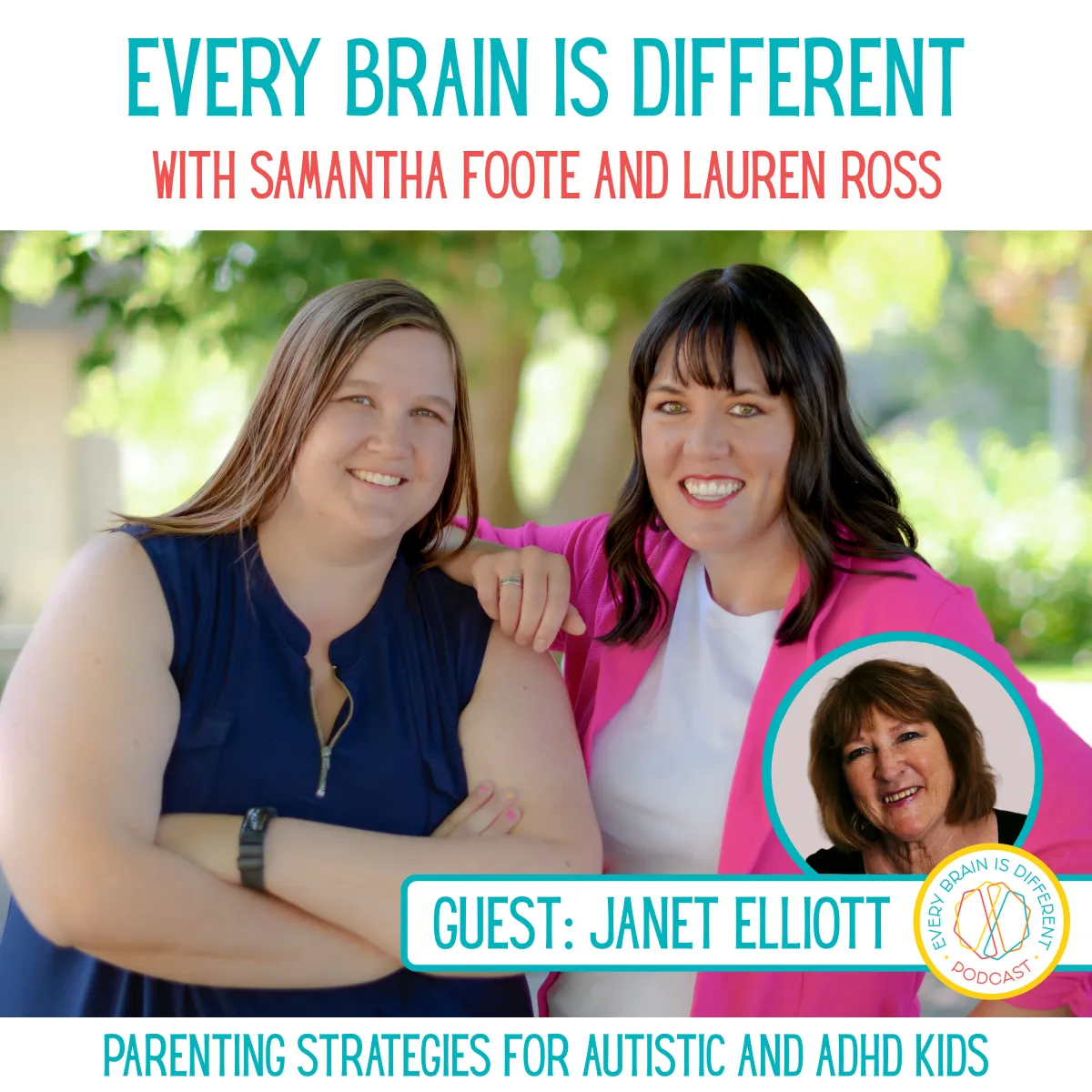
123- Advocating Before Autism Had a Name With Janet Elliott
Connect with Samantha Foote!
Instagram:https://www.instagram.com/everybrainisdifferent
YouTube:https://www.youtube.com/@everybrainisdifferent
Welcome to Every Brain is Different, the podcast where we celebrate the unique world of neurodiversity. We are your hosts, Samantha Foote, a neurodivergent, Board Certified Music Therapist and mom to three kids of ADHD and autism. And Lauren Ross, an ally to the neurodivergent community with over 10 years of experience supporting children and adults with autism.
This podcast is for parents like you. Navigating the world of neurodiversity with love and compassion. Together we'll create a world where every brain is valued and celebrated. We're excited to embark on this enlightening journey with you.
Transcript:
Samantha Foote: [00:00:00] Welcome to the Every Brain Is Different podcast.
We are here with Janet Elliot, and she is the author of The Alien Savant: My Autistic Brother's Journey Through a Neurotypical Universe. She's a retired retail corporation owner who draws upon her personal experiences from growing up with a developmentally disabled brother in the 1960s and 1970s. Her book offers a poignant [00:01:00] examination of the evolution of special education and family advocacy. Through a blend of heartfelt storytelling and extensive research, Janet provides valuable insights for educators, social workers, and parents of neurodivergent children.
Welcome to the show, Janet. We're so excited to have you.
Janet Elliott: Hello, Samantha. I'm really glad to be here.
Samantha Foote: Can you tell us a little bit more about how you're involved in the neurodivergent community? Like what I might have missed.
Janet Elliott: Current, currently?
Samantha Foote: Yeah. Or before or whatever.
Janet Elliott: I'm just, I'm using the book to help people understand how far special education has come from basically non-existent to what we have now and the fact, yes, we still need more. There's a lot more to do, however, the parents now have access to help. There's agencies and there's social workers, and there's the teachers. And the doctors themselves now know more about autism. [00:02:00] Back in the sixties, when my brother was born in 1961, there was no such a thing as autism. They, they had no name for that other than, very, sadly, most of the children that displayed any kind of behavior that wasn't the same as other children the same age. A lot of them were just labeled as retarded, mentally retarded, and they went into institutions. And back then there were a lot of institutions in Ontario, Canada where at, Michael grew up. Um, there were 20 institutions at that time. Now there's none. Because they slowly closed them all. When they realized years later that these, these are pe- people, these aren't, uh, they don't need to be locked away. They can learn, they can be part of society. They can get jobs, just be at home with their families, um, when they're young, not in a, in a iron crib.
Samantha Foote: [00:03:00] Yeah. I saw a picture the other day of kids that were in institutions back then and they were just chained, like a heat, a furnace, not a furnace. Back when, like the old things that they put up for heating.
Janet Elliott: Yes, the radiators.
Samantha Foote: The radiators. I knew it was radiators and I, I messed myself up for a second. But yeah, they were chained to radiators and it was so sad because people just didn't know how to, like, they had the, um, things on where their arms were tied down.
Janet Elliott: They all did to keep, because a lot of autistic children waved their arms. They, they move a lot and. They would do that to keep them still. They were afraid they were gonna hurt themselves, hurt somebody else. They didn't understand. They were not teachers. They, they weren't even really social workers. They were just the people who worked at the institution and they just gave a basic care. That's all these, they never got an education or [00:04:00] very little, you know, so it, it was very sad.
And my parents, of course, when they realized that something was wrong with Michael, and initially they just thought it was a hearing impairment, which it was, but they, they didn't know that the behaviors that were developing were also not of the, the, the norm that there was something else going on. But all my mother knew that was when a doctor said, “listen, he'd be better off in an institution with his own kind.” And she said, “no, he's with his own kind, his family.” And she, my dad and mom would not allow it to happen. And they did an incredible job over the next years fighting for an education for him and that he could stay at home.
Samantha Foote: That is amazing. I love that she didn't, she said not to put 'em in an institution. I am not blaming people who put their kids in institutions because when a doctor tells you this is the best thing to do, [00:05:00] like you want to trust the doctor.
Janet Elliott: Exactly! And they told these parents and they honestly thought the same thing themselves. The doctors and the psychiatrist thought that they better off with their own kind, with others like them, they'd feel more comfortable. They wouldn't have to deal with society looking down on them, which sadly that was going on. Absolutely. They were any intellectual or developmentally disabled children were looked at as, as not being acceptable. It, it was very sad. It really was. But because my sisters and I grew up with him and in that atmosphere, all of us have, all our lives have been very accepting of any child. That is a lit- We, we were like, okay, that's cool.
Samantha Foote: Yeah. What kinds of things did your parents do to advocate for your brother? Like for an education or just for services? What [00:06:00] kind of things did they do?
Janet Elliott: Okay. When he was really young, they, they started out, you know, 'cause there weren't very many schools for any kind of disability. Like you had some schools for the blind and some for the deaf, and that's where he ended up, was in a school for the deaf. Unfortunately, though, they couldn't cope with his behavior. They had no idea what was going on. Oh, and he was also nonverbal. And uh, they tried desperately because back then deaf children were not allowed to sign. Believe it or not, it was not permitted. Teachers were not allowed to teach using signing. These children had to learn to speak. That was it.
Samantha Foote: How did they learn to speak?
Janet Elliott: It was terrible. Like they just made them repeat over and over and most of them learned to lip read like, but Michael, because of the autism, he couldn't concentrate on anybody's face for very long, and he didn't like the eye to eye contact. So he, of course never learned [00:07:00] to speak and they kept trying. They tried for a number of years, the, the various teachers that he had, but, they couldn't find a place for him. They like, they tried different, they had a few assessment centers where he got to stay briefly. It wasn't until he got to about age 11 that they found a really, really good place. But again, it was a, an assessment a- behavioral therapy place. It was excellent in Toronto, but, and they made a concession for the fact that he didn't do well in residence. He, they tried it in, in some of the schools for the deaf and his behavior of course, especially 'cause it was so bizarre. Some of the things he did, they, they just couldn't cope with that. Umm. And so they, they were able at this is a therapy center to work with him, uh, just during the week, and then he would go home every night. And that worked much better for Michael. He was, he could, [00:08:00] he could work much better that way, and they did teach him a lot of coping mechanisms, but they realized that which, being oral was just not going to work.
So at that point, signing was now permitted. So they started teaching him to sign. He still was not good at signing. Because he could only understand concrete words, words that had a visual meaning, 'cause everything he did was visual. He was one of the, the picture thinking kids that a lot of the autistics are. They, that's how they learn. They learn by what they see. And this is how he learned pretty much everything. All his life was what he, what he looked at in a picture book or what he watched on television. That's how he learned things. And then he would draw them. That was, ended up being his main source of communication he could sign. Uh, but it was very, and he had his own signs that he made up, so we just learned what they were. But he, [00:09:00] he used his pictures to tell us something. He would draw it out almost like a, like a cartoon, like little or a movie. And he would have each frame showing what he wanted or what he expected to happen or just whatever thought he'd had.
But when he was older, when he was finished with his education, such as it was, and my parents kept on waiting for places for him and 'cause my dad and mom didn't want him to just sit there doing nothing, watching TV and, and not use what he had learned. So they kept finding him different programs, whatever they could.
My father found a ceramics classes for him when he was an adult, which he did very well until sadly, that, that lady retired. But then he found the real winner, which was computer art class. And again, he didn't know what he was asking the commuter, or computer lady for. She didn't really know what to do, but they worked it out. They figured out how to [00:10:00] teach him. And, and Michael himself sort of showed them what he wanted to learn and they worked it out and ended up being brilliant. Like he, he did a lot of really wonderful things like on the computer, wonderful pictures.
But again, that by then there were a lot more agencies to help. There was an agency that my dad found. That would support the, the classes that they would get paid, uh, to help Michael and things like that. And just getting disability for him, that was a heck of a challenge 'cause nobody had ever really done that. And he had, again, he had to fight, he had to go to court a few times to prove that, that Michael was disabled. He couldn't hold a job. He wasn't functioning well enough to do that. And the, they did eventually get him a disability pension.
Samantha Foote: Yeah. That is so awesome that your parents wanted him to do things, didn't [00:11:00] just let him sit around and got him things that he was good at and that he could do. And I just love that- it goes to show, like the differences in communication we always talk about and how he used pictures to communicate. And that's a valid form of communication. Just 'cause it's not talking like- he can still communicate. I know a lot of people say that if, “oh, if you're non-speaking, you can't communicate”, and that's just not true. And so, yeah, I love that he could communicate that way and that you and your family were able to work with him and then as he was an adult, just get him where he needed to be so that he was still using his gifts that he had. And while understanding that he has a disability, so he's, he's not up to where he can hold the job, but he still has other things to contribute, which makes me so happy.
Janet Elliott: It was hard work for them to do that, you know-
Samantha Foote: Yeah, for sure.
Janet Elliott: and frustrating a lot of the time when either the [00:12:00] person they approached about whatever, didn't understand, didn't really care. Um.
Samantha Foote: Yeah.
Janet Elliott: That, that happened to them a lot where they had to keep changing direction. And he even conta- my dad contacted the local politician at one point 'cause he was so frustrated with the, uh, school system that he couldn't find classes for my brother when he was young. And he approached the, the local MP and said, “Hey, like you're in charge of education. Educate my son, please.” Like, so.
Samantha Foote: Yeah.
Janet Elliott: And so they, they worked it out. They found something for him. And that particular, that particular school actually ended up become, it's now one of the best known schools in Toronto for divergent children. Yeah, so.
Samantha Foote: That's awesome. I know how hard it is to get the services that my kids need right now and advocating for them and going to IEP meetings and advocating, and I know that that's hard work, so I can't even imagine how much harder it [00:13:00] was when all those programs weren't established yet.
Janet Elliott: No, because they didn't even, there was no criteria for autism back then. The, the work wasn't even, no, there was no name for it, so, uh.
Samantha Foote: Yeah. What would you say to parents now who are raising neurodivergent kids? Do you have any like words of wisdom or advice on how they can help their kids?
Janet Elliott: Yeah, it's, it's all about accepting, uh, what problems they have, their weak areas. Accepting them. Not to say that you can't keep working on them, but take hold of those things that they're good at, whatever that might be, and really work on that 'cause a child's self-esteem if he knows he's done something good that he's made something good or he, he did the lesson that he was supposed to learn, or he- whatever it was you wanted him to learn and he did make, make sure you really build on that, that [00:14:00] he knows how wonderful he is all, all the time.
But at the same token, if you have siblings that they're all the same. You, you treat everybody you know, equal. You, you just adjust for, for your neurodivergent 'cause because the siblings will, they'll, they'll sort of follow your act if you, you're accepting of, of that, and they, they will be too. And, and other children watching when they, when you're working outside of the, the, the home- When you're in the classroom helping or, or doing whatever you're doing with your child in, in whatever social things they do if they're, if they're a Boy Scout or anything like that, like you can, you can be there and, and you can show them how to work with your child.
And, and not to give up everything when, when the child is grown. Like when you have an adult with on the spectrum that, that you're still there and you're still advocating and you're still making [00:15:00] sure that society knows, “hey, like this, this is my son. Just 'cause he is grown. He's part of, he's part of the whole picture here.” And that's where sometimes that gets tricky 'cause it's still hard to get neurotypical people and families to accept some, somebody who's a little different from what the different thinking, different brain.
Samantha Foote: Yeah, yeah. There are so many resources for children now and then it's like when they become adults, people think that they're just not autistic anymore.
Janet Elliott: Not as much, yeah. Definitely.
Samantha Foote: Like I don't- There is an awesome nonprofit in the Boise area called My Place's Community Events. And they have events for people who are adults with developmental disabilities like any disability. And they have events around the community that they can go to. Like I do a once month music group for them and I just go and we do a music therapy session once a month and it's so awesome. I [00:16:00] love that they're focusing on the adults and it's not just for kids because like, kids definitely need a lot of resources and parents need a lot of resources, but we can't forget about the adults either.
And then there's another business. She's a nonprofit, but she sells candy um it’s Zola's, what is it? Zola's Candy Shop or Zola's Sweet Candy Shop or something.
Lauren Ross: I think it’s Sweets like Zola-
Samantha Foote: It’s Sweet Zola! It's Sweet Zola's. It's Sweet Zola's. And this woman employs- She's actually been on the podcast, her name is Cindy Radanovich and she employs only people with disabilities.
Janet Elliott: I’ve heard about a company. Not that one, but I've heard of another one like that.
Samantha Foote: Yeah, yeah. There's a few of them, in like, around the country and I just think that's so amazing because these people can have jobs. But they might not- her goal is to train them in the job and then have them exit the program and go get a job [00:17:00] somewhere else, like at Albertsons or Home Depot. I know those are some of the places that her, that her previous employees have gone to, and so I would just, if you have an adult with disabilities, I would just look into community resources like that if there's any in your area. Just talking to people who are listening right now, because there are some amazing things that people are doing to help adults with disabilities.
Janet Elliott: Good. Good. Because that's what we, that's an area we really still need to work on and, and helping them just with their social skills, helping them cha- out out there. Like I have twin grandchildren. They are now 15 years old. They're both on the spectrum. So I know a little more about the current situation and they both have IEPs, very fortunately their high school, which is where they're at now, use their IEP. They can actually go to high school for five years knowing that they need a little more time [00:18:00] to, to learn and to, and they're learning a lot of social skills at this point too. And again, they take their strong, uh, subjects and, and, and integrate them into the regular high school class in that subject. And, but then they're, for any other weaker areas, they're still working a one-on-one with their special ed teacher.
Samantha Foote: Yeah.
Janet Elliott: There's, it's, it is just amazing that they, they're now doing that and I think it's wonderful. So, yeah. You're right. We gotta, yeah, we're doing well, but adults still need to, we gotta make sure we don't forget them just 'cause they turn 18, 19 years old. That, and, and to make sure that you have, as a parent, that you have a, a social worker or an agency, you have some person that you contact if you have any concerns with your adult child and that you can talk to. That, that can help you with whatever you might need help with at that [00:19:00] stage of the game, yeah.
Samantha Foote: Yeah, for sure. Like leaning on, I know there's, we've mentioned Idaho Autism Moms group on here. There's other groups in other states and other countries, um, but Idaho moms- Idaho Autism Moms, is great for if you have a kid or if you have an adult, you can just ask, especially during that transition period. Because I know like, if your kid is on Medicaid and they're transitioning to adult Medicaid, like that's a whole process
Janet Elliott: Oh boy.
Samantha Foote: And if you have to get guardianship, that's a process. And so just having those people to lean on that you can ask is really beneficial.
Janet Elliott: Yes.
Samantha Foote: Yeah.
Janet Elliott: Yes, absolutely.
Samantha Foote: So you have a book, the Alien Savant, and can you tell us where can people find that and where can people find you online? Like tell us more about the book and then where people can find it.
Janet Elliott: Okay, the book is the story of Michael. Um, what happened was I, we were clearing out my parents' house to get it ready to sell 'cause it had [00:20:00] been left to us. And I came across this one box amongst the many other boxes. I also got given all, Michael's- I had always pictures and they were pretty old, and the paper was starting to crumple and I thought, geez, I gotta get these printed or done some, do something with them., so before they completely fade away and, but I just intended for the family, just know. And then I found the box with all his school records and all his psychiatric records. It was incredible. I started reading through them and going, oh. Wow. There's a lot of things happened to him that we didn't know about. I, I don't think my dad even really had read these before he passed, and unfortunately, but I thought, I've gotta make a story. I have to tell somebody what, what, what went on back then, and that's what I did. So having no idea what I was doing.
But anyway, it, it's, it's a good story. It [00:21:00] really is, and it's very encouraging for anybody now who gets frustrated and thinks, “oh, I can't keep doing this.” That yeah, yeah, you can. And, and there's, but now there is a lot more help than there was back then now, and, and that's what it's mainly about. So it's that you can, you can help your child get accepted.
And the book's available in the usual places. Amazon, Barnes Noble, there's a particular one called bookshop.org and it's an excellent, uh, program in that if you order a book through them and you give them the name of a bookstore that you really like, they will donate some of the proceedings to that bookstore for you. So it's a, if you're a reader and you like to advocate for, for reading, that's, that's a great way to do it. But here in Canada there's Indigo Chapters. It's available through them too, so it's [00:22:00] all available online. Um, and then I have my website, myguidedpan.com. Uh, if you wanna read a little more about me or you wanna talk to me, I'm, I'm here.
Samantha Foote: Awesome. Thank you.
And our last question is, what do you do for fun?
Janet Elliott: What do I do for fun? Love board games. I'm a, one mean Scrabble player. Um, geez. I go walking. I love traveling. I've got a trip planned to the East Coast in a few weeks in June. Love being with my family. It's small but mighty. That, that's mainly, I like, I'm. I like slot machines. I like Las Vegas.
Samantha Foote: Nice, nice. I never gamble. And one day I was like, I'm going to do a slot machine. And I didn't know what to do. And so I like, they, they, they popped up with all these things asking me questions and I'm like, I don't think this is what I thought it was. So [00:23:00] anyway, it was just funny. I was like at a random gas station in Nevada and I was like, I'm gonna do it. And my mom, who is very against gambling was like, “what are you doing? You can't do that.” I was like, “I'm gonna do it.” So anyway, it just made me laugh.
But yeah, thank you so much for coming on the podcast. We really appreciate your time and I love the book, so people should get it and read it. Listen- Um yeah.
Janet Elliott: It’s an easy, easy read. It’s not a hard book to read.
Samantha Foote: Cool. Well, thank you.
Janet Elliott: Thank you, Samantha. Thank you, Lauren.
Lauren Ross: Thank you. You're great.
Samantha Foote: Hey everyone. Samantha here and I'm thrilled to invite you to join me for something special, the Parenting Power Hour. This is your chance, parents and neurodivergent kids, to bring your questions directly to me and fellow parents in the room. We're here to help you develop actionable plans that really work so you can finally stop the meltdowns and find peace. In your home as a mom to three kids with ADHD and autism. I've seen and been through the [00:24:00] challenges too, so trust me, we'll find solutions together that fit your family. Don't miss out on the Parenting Power Hour. It's a free online monthly gathering every second Thursday of the month from 12:45 to 1:45 Mountain Standard Time. Visit everybrainisdifferent.com to reserve your spot today.
Well, Lauren, I thought that was a very enlightening conversation about how it was back in the day and I really enjoyed it. It's very sad though, what people told what, where people went, but I'm glad that her brother was able to stay home and get this support services, kind of, that he needed. They tried.
Lauren Ross: I mean- Yeah, I think for what they had back then, and I think props to his parents for, for putting in the fight. Especially back in that time when, when there wasn't the resources.
Samantha Foote: I couldn't believe, oh, sorry. Um.
Lauren Ross: Oh, I was just gonna say like I, it hurts my [00:25:00] heart, like the stuff that I know happened in institution, an asylum, stuff like that. And some, I know on Facebook posted something yesterday, actually, that said, “blaming a certain political party for getting rid of institutions and we shouldn't have done that,” and stuff like that. And I was like. Where is your humanity? We got rid of them because of the amount of abuse and neglect and like, like the horrible things, like how we treated people and how we thought we were doing right by them, by the way we treated people and I was just like flabbergasted that like someone still has those like opinions today and I was like, oh my gosh, I’m gonna scream. But you know, Clint, I think we, we had him on, he one time said, he's like “my goal is like my kids as kids is gonna look back on how we treat people today and think it was horrible.” Like we have that much more to go, to be better in how we interact and, and [00:26:00] treat and include individuals who are neuro divergent. And so like just from there to now, like we've made so much huge improvement, but there's so much more to go. I think. So.
Samantha Foote: Yeah. I'm appalled by what happened even 20 years ago when I got into the field. Like-
Lauren Ross: Yeah.
Samantha Foote: I was told, I was told that if a kid was stimming to stop the stim, tell them to stop. I was told to restrain kids who were being aggressive and it, it, it didn't feel right to me, and so I didn't-
Lauren Ross: Yeah.
Samantha Foote: Or I was told that I needed to make objectives in my music therapy goals to have kids make eye contact.
Lauren Ross: Oh, that's such a big thing. And it's like, uhhh.
Samantha Foote: And, I just look back on that and it didn't feel good to me to do that.
Lauren Ross: Yeah.
Samantha Foote: And I did not do that for very long. It was like less than a year. And I was like, I'm just not gonna focus on these goals. And I'm not saying that the people who told me to do that were [00:27:00] bad. I'm not blaming them. That's just, the, that's just how it was done back then. It was
Lauren Ross: It was the knowledge and the education that they had.
Samantha Foote: Yeah, yeah.
Lauren Ross: And we don't know what we don't know, but like we do know a lot more now and so we do need to do better.
Samantha Foote: I hope the same thing is Clint, that our kids will be like, “what were you doing? Why were you doing that?” And it's crazy to me that these institutions, it, they seem like they were so long ago. But it's within my parents' lifetime. Like my parents were born in the sixties and so the, it was within their lifetime that all this was happening. Like when I think about it, I think, oh, that was like a hundred, 200 years ago. But it really wasn't-
Lauren Ross: It’s not, yeah.
Samantha Foote: It was in the last 50 years.
Lauren Ross: Yeah.
Samantha Foote: And that is just wild to me that we, we've come a long way and I'm glad, but we still have so much farther to go.
Lauren Ross: [00:28:00] Especially and I, especially for adults, like, like we mentioned like there, there are a lot, lot more resources and push on, on getting children know the resources and the help, but once they, they turn 21, like it just drops off and it's such a fight. And so I just wanna give another shout out to, to My Places and a Sweet Zola’s Candy 'cause they're doing great things for adults and getting them into the community and, and doing things that they love and enjoy. Recreational and work and all of that, like I think it's great. So if you're in the local area, definitely support them.
Samantha Foote: Yeah. And if you're not in the local area, Sweet Zola's does deliveries. They do subscription boxes, so you can order a subscription box from them and they will send you a box of candy every month. So.
Lauren Ross: Love it.
Samantha Foote: I mean, people are gonna buy candy anyway. You might as well buy it from a good cause, so. Yeah.
Lauren Ross: Exactly. Exactly.
Samantha Foote: For [00:29:00] sure.
Thank you everyone for listening this week. This was kind of a hard conversation to have, but I'm glad we had it. I mean, I say that, but I, it's not like I was affected by any of it, but it's just knowing that it was so recent that it happened. That it, my, my heart does break for the people who had to be in those institutions and living through that. Because they really shouldn't have had to, but it's what like, people don't know what they don't know. They were just doing what they thought was best and we can only move forward. So, yep. So thank you everyone for listening, and we will be back next week with a solo episode. So have a great week.
Thank you for listening to today's episode. We hope this discussion on neurodiversity has provided you with support, understanding and inspiration. If you're looking for more support, Or you can go to everybrainisdifferent.com and download the ultimate guide to parenting your neurodivergent child.


