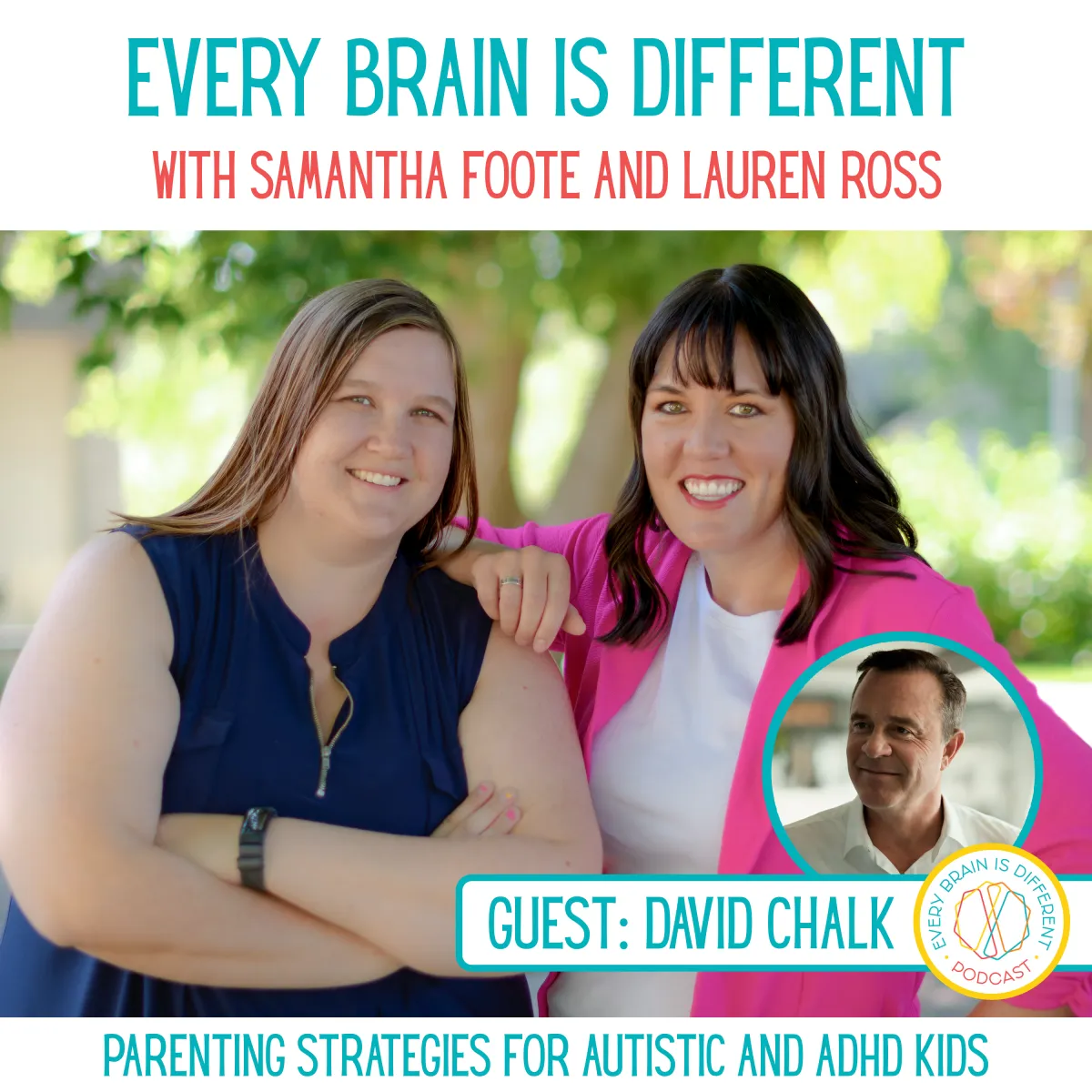
104- Curiosity Over Shame- Helping Neurodivergent Kids Thrive with David Chalk
Connect with Samantha Foote!
Instagram:https://www.instagram.com/everybrainisdifferent
YouTube:https://www.youtube.com/@everybrainisdifferent
Welcome to Every Brain is Different, the podcast where we celebrate the unique world of neurodiversity. We are your hosts, Samantha Foote, a neurodivergent, Board Certified Music Therapist and mom to three kids of ADHD and autism. And Lauren Ross, an ally to the neurodivergent community with over 10 years of experience supporting children and adults with autism.
This podcast is for parents like you. Navigating the world of neurodiversity with love and compassion. Together we'll create a world where every brain is valued and celebrated. We're excited to embark on this enlightening journey with you.
Transcript:
Samantha Foote: [00:00:00] Welcome to the Every Brain is Different podcast. We are here with David Chalk. And David, thank you so much for coming on the show. We really appreciate your time.
David Chalk: Thank you for having me.
Samantha Foote: And can you introduce yourself and just tell us a little bit about how you're involved in the neurodivergent community?
David Chalk: All right. Then, uh, you know, we don't get to choose whether we're neurodivergent or not, and I spent a lifetime [00:01:00] not knowing that. When I was 42 years old, I got diagnosed, and when I was diagnosed, the people that did it said they had never come across a case so on the edge of the numbers, in the one percentile. And that's ADHD, dyslexia, and a whole host of other things. I, I have a weird one called prosopagnosia. You can't recognize faces. And that ties in a lot to reading, because the area of the brain that does reading, which was a big challenge for me, is tied into the facial recognition area. So finding that out, I started talking about it, and I did a lot of talks, and at those talks, I would give out my email address and people would follow up with me. And I would sort of help them out, parents usually of children. In 2000 and, in, in 2021, through that, I was offered an opportunity to learn to read on a new methodology. So I got flown to Michigan and I took a one-week program, one-on-one [00:02:00] instruction, only one hour a day, and at the end of that week, I...Prior to it, I was tested at, like, a grade five reading level. Obviously I, I've got, um, vocabulary and I'm a business person, but I couldn't read fluently. And 11 hours later, I could read at a post-university level. So what I'm doing now is, I'm developing software. It's an application that'll be AI-based for the home for parents whose children typically, when you have challenges like this, neurodivergent of any way, you live in fight or flight. And that's what makes it so hard, because in the early years of the classroom when we're so vulnerable to challenges and the shame and the humiliation, that's when the problem really comes. It's unfortunate that it's reading that is taught first for those first three years, but once the child shuts down, then it can be a very challenging life.
So my goal, and I hope to give it away for free to most anyone who needs it, is a methodology to [00:03:00] teach people to read in the home, go to school, and enjoy it
Samantha Foote: Yes, that is so important. I know I've talked about this before, that my son, even in preschool, he knew that he was behind his peers, and he hated reading. He hated it. And then he wasn't able to read, 'cause he had vision processing disorder, auditory processing disorder, and he had all those things, and so school was so hard for him. But we got vision therapy, we did the Cool Minds program. And now he's able to read a little bit better, but he is still struggling. He's still struggling with spelling, and that's even gone down to his brother, where his brother can read. His brother doesn't have as many challenges as his older brother does, but he's like, "I hate reading. I don't wanna do it," because his older brother had that attitude. And you're right, like, he hated going to school because it was just so hard, and he knew he was behind his peers, so he felt that shame-
David Chalk: Mm-hmm
Samantha Foote: and all of that. And so, yeah, [00:04:00] tell us more about your program and how you're hoping that it can help kids and all of that.
David Chalk: Well, y- you said what parents can do, so I'm gonna give you one other thing first.
Samantha Foote: Yeah.
David Chalk: That's what I'm doing to change the future. But what can be done right now, my life, I made it through okay because of my mum. And I think, and many, like you with your children, mums get very deeply involved because they do spend a lot of time. But- I can tell you how important it is, because my mom never got upset with me. The fact that I could not learn, the fact that I got the lowest mark, the fact that I hated reading, the fact that I hated going to school. She always made it a good environment when I got home. It would be positive. We'd play games. Uh, we'd paint, we'd draw, we'd cook. We'd do all sorts of other things, and I think for most parents, they know their children [00:05:00] accelerate in other areas. It's just that, that strictness and that methodology of the classroom.
So for me, I would write it down to unconditional love, and I know the parents out there give that, but you can never give enough. And for their child, what my mom did for me, without her even knowing it, she taught me consciousness, and what I mean by that is we're not the voice we hear in our head. Now, for people who don't suffer a lot, they don't know the negativity that goes on. I mean, the average person gets it all day long, but not as horrific as someone that is-- has learning disabilities or neurodivergent. It's telling you all the time, reminding you of everything that everyone has ever said to you. And she was able to teach me to separate it, that if I know that voice is there, then there must be something listening to it or watching it, and that consciousness, that awareness of knowing you are [00:06:00] not your-- the voice in your head, which is your thinking. She taught me that thoughts are the magic thing in life, that we only get real thoughts when we calm our mind, we breathe, and we don't think negative, and you will find the thoughts are really positive. Most great people, when you ask them, "How did you do that?" They, "I don't know. I just had this thought one day." And, and you can make... Well, you can't make them happen, but those thoughts are able to occur when we get out of our head. And what she would say to me all the time, "David, get out of your own way." Because when we are upset and we're frustrated, we're just acting out a story in our head that we've come to believe. So I had this ability, even though there was a lot of pain, I could step back and I could go, "Oh, look at that. My mind is telling me this and that," and then I would- Calm down, and then I would carry on. Now, it's one of those things that does take practice, but I had a whole childhood of doing it.
And [00:07:00] so people often ask me, "How is it if your difficulties were rated so high, your neurodivergence," I'm slightly on the autism spectrum as well too, "how did you make it through life?" I started a lot of businesses. I became an airline pilot when I was 20. My ADHD, I couldn't sit in the flight deck cockpit and I just went crazy after five hours of flying. And when I was learning, it was fun. It was a thrill. I mean, ADHD side of things, spinning a plane upside down, perfect, right up my alley. But after that, no. I then got into computers, and I actually built a couple of multi-hundred million dollar companies. And I'm not saying that to impress anyone, but I'm saying it that parents of neurodivergent children should know that 40% of all really successful people are neurodivergent, and 30% of all n- self-made millionaires in the world are neurodivergent. You just have to look at the tech industry. It's just full of them. So on that side of [00:08:00] things, it is hard for a child in school. It is hard for the parents because you're constantly hearing negativity. But if they focus their energy on ensuring that their child knows it will be okay one day, maybe it isn't gonna happen in the classroom, but when you have the opportunity to get out into the world, anything's possible.
So that's the real thing. You can't fight and make a child want to learn. It only puts them deeper into fight or flight, and the cortisol and the adrenaline which is released into the body actually shuts the brain down. That's why we get, "Oh my God, my brain hurts. I can't do this anymore." In fight or flight, the way evolution worked, it was there to get us away from danger. The last thing it wanted to have you do was try and think your way out of it. It wanted you to run or fight or get the heck out of there. So it actually kind of neutralizes the, the thinking part of the brain a bit. And for [00:09:00] people with learning disabilities or neurodivergency, we know it. We feel like we're getting dumber. The more worried, the more stress we get, and then it just amplifies and amplifies. So it's a matter of calming down, getting out of that voice, breathing, like everyone tells you. But breathing is the trigger for the amygdala, which releases those cor- hormones into the body to say, "Well, if this person is breathing calmly, there can't really be danger." That is the magic of breathing. It's not just to get the air going in. That is the clue that the amygdala looks for to say, "You know what? Maybe we got the situation wrong. Maybe it's not as bad as we think it is." And if we start to breathe calmly, those chemicals start to go down.
Samantha Foote: Yes, that is so important. I never thought about it like that before, that I know I've heard many people say many neurodivergent people live in fight or flight because their environment is overstimulating. They're constantly, [00:10:00] like, being told to do things that they can't do. And so they're in fight or flight constantly. And so I love that you said to breathe-
David Chalk: All the time. Mm-hmm, yeah.
Samantha Foote: ... and trigger the amygdala.
Samantha Foote: And I never thought about that, that if you're breathing and you're breathing calmly, then your body's gonna be like, "Oh, what am I doing?" Like- "I'm fine."
David Chalk: Right. Yeah. And, and it's all connected to a thing called the vagus nerve, and when that calmness hits, the entire body starts to relax. The thing you want to do is stop those hormones of cortisol. It's absolutely horrific. And for children, they live in it all the time. It makes them angry. It makes them frustrated. It has them do the things that people wish they wouldn't do, but they can't help it. And the more we push on them, the m- the more we try and stop them, not aggressively, but we just say, "You've gotta stop that right now," it won't, it won't do it.
The best thing you can do then, a hug. And a hug is another magic thing. There are two ways to [00:11:00] calm the amygdala, and every mother out there knows this, but they may not know it's true. When there's a newborn baby and that baby won't sleep at night or won't eat or has colic or anything, you hold the baby tight to you, and then you swaddle it in a tight blanket, which seems like, where did that ever come from? Why would we wrap a baby so tight that they can't move? Because it actually causes the amygdala, again, to know that you are in a safe environment, that that hug... That's why people, when they're really frustrated or worried, they go, "I need a hug." They don't even know why they need a hug, but what it does is it releases oxytocin in the body, which is a counteractive neurochemical to the cortisol. So there are things we can do, and they're right there all the time. Breathing and giving someone a hug and just holding them, count to 10 or 15, they'll calm right down. [00:12:00]
Samantha Foote: Yeah. Yeah. That is great. I know that we had Dr. Sadia Sardonicus on the show, and she said to do squeeze hugs, where you take your hand and just squeeze your arm or squeeze your legs, or she said that the feet are the best place to do it, 'cause it's, like, the least, I can't think of the word, but just not as intimidating as doing, as, like, doing your arms or something like that. And so, yeah, just giving squeeze hugs, like squeezing your fingers, anything like that. And they can do it to themselves, and I think that's a good part of that, is that they can do it to themselves so they can calm themselves down if a parent is not there or someone else isn't there to do it for them.
David Chalk: But there's nothing more powerful than the torso, because we have so much surface area there that if there is a parent or a loved one around and they just hold them, you see, in all the movies, when there's trauma or there's anything wrong, you just see someone holding the other person. [00:13:00] Nature, evolution has this in us, even though we may not know it specifically. It'll work wonders.
Samantha Foote: Yeah, for sure. I was reading an article that you sent me, and it says that you have one request for all parents, and that is to be curious, and I want to know if you could expand on that and what you meant by that.
David Chalk: Sure. When a child is born, and they start to walk, and they start to explore the world- They have no fear. There's only a few fears they say they have. One is falling, and I forget what the others are because I'm not a doctor. But the one thing they have is curiosity. They'll put anything in their mouth, they'll crawl anywhere, they'll try anything, they'll ask the same question 10 times over because they haven't yet been conditioned to manage themselves in such a way that society says [00:14:00] you can manage yourself.
And for a neurodivergent child, they hear "no" a lot of the time. They realize they can't do a lot of things, and when that, we'll right back to it again, amygdala kicks in out of worry and anxiety, that's fight or flight, always the same thing, that cortisol starts going through the body, you get a feeling of anxiety and fear, and the first thing to go is curiosity. You don't want to step out. You don't want to ask questions. It's why they shut down in the classroom. And I can give you one good way to think about it. If you were standing at the entrance of a, a dark cave or something along that line, you can be fearful. You certainly wouldn't go in. But if you're curious, you might just take a look and realize there's something interesting. I'm not saying that people ought take, to take away any caution, but curiosity is the [00:15:00] antithesis of everything that has a child in fear. And if you see them being curious, wanting to know things, wanting to learn, wanting to understand, you lean into that, and that's exactly what my mom did. As I started to realize I could perform well outside of school, I became very cl- curious about everything in life, and that is how I live my life. I'm always open to learning something new, and that's sort of where my direction is now for, for helping other people. I was very curious on how the brain worked and why reading didn't work and why children suffered so much when they're neurodivergent, when they're actually really intelligent. It all comes and hinges back on reading in those early grades
Samantha Foote: Yeah, for sure. I can totally see how that happens.
Samantha Foote: Hey everyone, Samantha here, and I'm thrilled to invite you to join me for something special, the Parenting Power Hour. This is your chance, [00:16:00] parents of neurodivergent kids, to bring your questions directly to me and fellow parents in the room. We're here to help you develop actionable plans that really work so you can finally stop the meltdowns and find peace in your home. As a mom to three kids with ADHD and autism, I've seen and been through the challenges too. So trust me, we'll find solutions together that fit your family. Don't miss out on the Parenting Power Hour. It's a free online monthly gathering every second Thursday of the month from twelve forty-five to one forty-five Mountain Standard Time. Visit everybrainisdifferent.com to reserve your spot today.
Samantha Foote: I was going to ask you what led to you getting a diagnosis. You said you were 42 when you got your diagnosis? Yeah, what led to that?
David Chalk: Weird sort of, I was watching, I don't watch a lot of TV, but one night I was watching the History Channel, and there was an actor on there, I can't think of his name right now. There was an old show [00:17:00] called Happy Days, and his, his role was Fonzie on it. And he was a well-known actor. And as he was being interviewed, he told that he, at roughly the age of 40, was diagnosed with neurodivergent dyslexia, ADHD, all sorts of things, and that he had sort of lived a life of hell. He went into acting because it gave him some peace. It was a curiosity that he could be different and explore, and not have to be that person that sort of society had put over top of him. And right when he said it, I went, "Oh my God, I don't even know what dyslexia is." And so I looked up that word, and I had to figure out how to spell it first, and found testing places that usually do children. But I said, "Would you test me as an adult?" And they did. And it was from there that I found out there was a whole plethora of things that had me understand why I thought life was really difficult.
[00:18:00] It's hard to know whether it helps a child to know that they're neurodivergent or dyslexia or ADHD, because they can label themselves pretty hard. The education system needs to know because they can give them alternate education with it. But for me, as painful as it was, I think it taught me a great lesson. There was a lot of suffering in there, but from that it gave me a lot of strength, and that's what kept me going all the time.
Samantha Foote: Yeah. Thank you. I hear a lot about people that come on this show that they got diagnosed, like, later in life, midlife, and they didn't know what was, quote unquote, “wrong with them”.
David Chalk: Life's hard.
Samantha Foote: Yeah. Yeah. And so they were like, "Why is my life so hard?" And it was just, it helped them understand and give more understanding to their life circumstance. So I just like to ask what led you to being diagnosed?
David Chalk: I would've, I would've never even thought about it. I was [00:19:00] so used to who I was. I have coping skills for everything, and you could live life and manage, but you're always on guard. And I was always in fight or flight. At 42 years old, I was still living in fight or flight. I was running big companies, but- Inside of me, I felt like a fraud. I felt like the, someone was gonna pull the curtain away and we're gonna find a person who couldn't do anything. Because as a child, I was also, at the time it was called mental retardation, I was put into a special school until my mom got me out. Because it wasn't that I couldn't learn. I was very creative. In fact, I, I was tested on IQ level and I was very high. But they could not understand why I couldn't learn. Well, fight or flight. The moment you go into that, as I said, those neurochemicals literally shut part of the brain down, and that has it such that you do not want to learn. Even though you want, I gotta find, you don't [00:20:00] feel you can learn, but you want to learn.
Samantha Foote: Yeah. That's an important thing to remember, that if a kid is looking like they're defiant, it's not that they don't wanna do it, it's that they can't do it.
Samantha Foote: I think that's an important thing to remember.
David Chalk: You-
Samantha Foote: Do you..
David Chalk: think of…
Samantha Foote: Sorry, what?
David Chalk: I was gonna say, you think of someone being given a drug, there's some terrible drugs out there that make people very violent. Well, those hormones in our own body that we generate can be just exactly the same. They have so many side effects that we can't get control of. But by practicing what I said, my mom told me was, it's when you hear that voice kind of telling you you're mad and everyone's angry at you, you, you, you act out. But the more we can pull away from believing it's true, the calmer we are. And when we're calmer, then we're not frustrated or angry.
Samantha Foote: Yes. I love that.
Do you have any other resources that you have or would recommend to parents?
David Chalk: Give me an example.
Samantha Foote: So, [00:21:00] like, some people have, like, books that they might recommend to read, or podcasts, or just other programs that they've done, something like that.
David Chalk: Well, n- no. I don't-
Samantha Foote: Okay.
David Chalk: -really. Because I work with the brain and the mind in my world, and if a parent would investigate further, books that they wouldn't normally read, cognitive science based books, or the way the brain actually functions under stress, or neuro...
They would've obviously read many on neurodivergency, but look at it from the brain side of things. They will learn so much, and obviously after that I, I looked and I didn't read a lot because I couldn't read at the time. That was one other factor in it. But it all comes down to- The three things, unconditional love, accept them for who they are, and help them [00:22:00] understand they are not the person other people say they are. And with that, if I had nothing else, no other tools, no other books or anything, and if I had, if my children had inherited what I have, which they didn't fortunately, I could have supported them by only doing that because I know that it works
Samantha Foote: That's amazing. Thank you for that. I really appreciate that.
Where can people connect with you online if they're looking to maybe ask you some questions or learn more about what you're doing?
David Chalk: Yeah, I'm really open about that. I'll give you my email address, and believe it or not, I do answer all the emails, uh, because most people think I'll never answer, so I don't get as many as they think. So email address is my first name, David. You can see it on the screen there, and the @chalkcorp, as in corporation. So [email protected]. If they have a child who can't read, there isn't anything there now because I'm still developing it, but my product will be called Reading [00:23:00] Road, like the road, the path.
Samantha Foote: Mm-hmm.
David Chalk: Readingroad.ai, and they can sign up there, and it will be available for free to them to use through their computer, and it's very advanced. I was recently invited down to Stanford University to discuss with them how advanced this was and how different. It's not like online learning. It is fundamental reading. It teaches reading the other way around. It teaches not reading a word off a page, but how did the word get on the page? And that is, if you can say a word like cat, and then a child can learn that it is c-a-t, and they learn the sound-symbol relationship, if you write it on the page, you have spelled it. And if you can write it on the page, you can read it. So this entire model is a complete reversal of the education system, not teaching to read, but teaching to write. And it's such a, a, a focused methodology of symbols and sounds and learning those, that there's only 26 [00:24:00] symbols and 44 sounds in the whole English language. We can master that pretty easily, and then you can spell every word on the planet Earth. And if you can spell a word, you can read it. So that is what I'm bringing, and the, the research on it and the studies on it are revolutionary. It's too difficult for the schools to ever get involved because you have to teach it one-on-one, and that's why I'm training the AI to understand facial emotion, voice, eye movement, intonation, and it will provide that teaching to them. The parent can be there. They can be doing it on the couch. But it is a tutor that knows them, provides a completely different way of learning to read, and we're talking a fraction of the time in the results. I don't wanna say 'cause people won't believe it, but I told you I learned to read in 11 hours. Now, I'm an adult, and it is different, but we've got children going through three years of education, and they can only read at a grade one level. Well, I can assure you that anyone using [00:25:00] this type of methodology in kindergarten would be reading probably at a grade three level in grade one. Now you've stopped the stress, you've stopped the anxiety, you've stopped the shame, you've stopped the humiliation, and then comes back curiosity. They're in the classroom. They're not hiding. They want to know what is going on. That is when you know that the child is peaceful. Curiosity is the secret. They laugh, they're inquisitive, they wanna know.
Samantha Foote: Yeah. That sounds so amazing. I am excited to see when you get it done.
David Chalk: Mm-hmm.
Samantha Foote: Well, thank you so much for coming on the show.
Our last question is, what do you do for fun?
David Chalk: Well, I, I get outside. I like the air. I like to clear my head. As I said, thoughts come when your head is clear. So I will walk, I will run. I, and where I live in Canada, we ski and, and snowboard and do a lot of things like that. I love mechanics [00:26:00] and engineering, so I rebuild cars, and all sorts of fun things like that.
And I have a son and daughter who are in their early 20s who live with me, and we try and do all sorts of things together, too. So for many people that would've gone through what I went through, they'd live an okay life, and they may not be really happy, but I can tell you on a scale of one to 100, my joy and happiness is 100 every day.
Samantha Foote: Good. That's amazing. I love it. Well, thank you so much for your time. We really appreciate it, and thanks for coming. Yeah.
David Chalk: Thank you. You’re welcome.
Lauren Ross: Thank you.
Samantha Foote: What did you think, Lauren? I thought his ideas and his suggestions for what parents can do to help their kids was fantastic, but what were the highlights for you?
Lauren Ross: I, I think, you know, that what the unconditional love, like honestly, like love can, can do a lot. I, I like that he said, you can't get upset with your kids when it comes to if they're not learning something or if it's a struggle or if they don't want [00:27:00] to. There's tons of things you can get upset about, but that shouldn't be one of them.
And I really liked that focus on curiosity. I feel like if, if your kid is not being curious about things, I think we maybe went awry somewhere, somewhere, because kids are supposed to be curious. And I think, like he said, like when they're hearing, “no, you can't do that, stop”, that's gonna stop, right? Like the curiosity is gonna stop. And so I like, we always say, be curious, you know, about your kid, and, but let's remind our, the kids to be cur- curious as well.
And so I like that his mom taught him to not get in his head and to, yes, there is a voice there, but it's not who you are. Like, you're more than that. You're not what people say, and, and to get out of that mindset, and I, I'm sure that's going to be a little bit d- difficult to, to teach a kid. Like I, I mean, I struggle as adult to get out of my [00:28:00] head, but I think they're important reminders and just loving your kid, accepting them for who they are, and I j- I love it. And I'm very curious about his product and that, and so I'm excited to, to learn more, especially when it gets complete and stuff like that, so.
Samantha Foote: Yeah. I think if we would've had his product for my son- It might not have been such a difficult journey to get him to read. Like, now he's reading. He has read, like, he loves the I Survive books, and I am just so proud of him for how far he's come. He was talking about how he got Fun Friday last week, and I was like, "You don't get Fun Friday every week." He's, "No, you have to do so much stuff to get it. You have to finish all your homework, you have to do this, you have to do this." He's, "I am so proud of myself for getting it this week." And I was just so excited that he was proud of himself and voicing [00:29:00] that.
Lauren Ross: Yes.
Samantha Foote: So, yeah.
Lauren Ross: Yeah, celebrate that. Celebrate that win. Yeah. Celebrate that. I love it.
Samantha Foote: I bought him, we went to the outdoor show, and I bought him this little, it's like a mini license plate it looks like. But he wanted it so bad. It is of a man in a suit riding a dinosaur with an American flag in the background. And he was like, "Mom, can I get this for earning Fun Friday?" And I was like, "Absolutely," like, "you deserve it." He was so proud of himself. He was, like, telling everyone, and then he had me buy him a clipboard so that he can do his homework on the bus and he doesn't have to write on his lap, and I'm like, "Who is this kid?" But just-
Lauren Ross: Right.
Samantha Foote: ... doing what David said, like unconditional love, telling him not to get those thoughts in his head, and just supporting him and not making him feel [00:30:00] like he's a terrible person 'cause he can't read.
Lauren Ross: Yeah.
Samantha Foote: Yeah. So I think those are very important things to do, and his suggestions were spot on. Your kid already feels bad that they can't read. They already feel bad that they're not doing great in school. They are, I guarantee you, they are trying their hardest. Yeah. So if you make them feel bad or you punish them for not doing well in school, it's just gonna make everything worse.
Lauren Ross: Yeah, just escalates it.
Samantha Foote: Yeah. Yeah. But anyway, thank you all for being here this week. We appreciate you listening. Let us know if there's any subjects that you wanna hear about or any guests that you have that would make amazing guests for the podcast. And yeah, we'll see you next week.
Lauren Ross: Thanks, guys.
Thank you for listening to today's episode. We hope this discussion on neurodiversity has provided you with support, understanding and inspiration. If you're looking for more support, Or you can go to everybrainisdifferent.com and download the ultimate guide to parenting your neurodivergent child.


